Welcome to TiddlyWiki created by Jeremy Ruston; Copyright © 2004-2007 Jeremy Ruston, Copyright © 2007-2011 UnaMesa Association
//Brian Choi//
Allosteric control is the mechanism whereby a control molecule binds to a site on a protein, inducing a conformational change at a distant site, which affects the function of the protein. It is the fundamental molecular control mechanism in the cell, the basis of many steps in the signaling pathways, including regulation of gene expression.
We are building artificial allosteric control modules on different proteins, based on a new molecular engineering approach, which allows to exert a mechanical tension on the protein, externally controlled. The fundamental question we address is the physical nature of allosteric control (what does it take to make the protein change conformation ?). Biotechnology applications we foresee for the new molecules include a new generation of amplified molecular probes, and “smart drugs”.
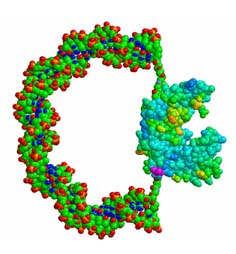
In the case of the Maltose Binding Protein (MBP), we show that a mechanical stress which favors the “open” conformation of the molecule, applied by means of a molecular spring attached as shown below, lowers the binding affinity for maltose. In fact, the binding affinity can be modulated by varying the mechanical stress.
[>img(35%,)[images/chimera_brian.png][]]
//Tension in the DNA “molecular spring” favors the open conformation of the protein, lowering the binding affinity for the substrate. //
[>img(45%,)[images/chimera_activity.png][]]
//Mechanical modulation of the binding affinity of MBP for maltose. As the stiffness of the molecular spring is increased (increasing L = length of the complementary strand hybridized to the ss DNA of the chimera above), the binding affinity K decreases. //
*B. Choi, G. Zocchi, S. Canale, Y. Wu, S. Chan, L. Jeanne Perry, “Artificial allosteric control of Maltose Binding Protein”, Phys. Rev. Lett. 94, 038103 (2005).
//Yan Zeng, Awrasa Montrichok//
As the temperature is raised, the DNA double helix melts through the formation of “bubbles” (single-stranded regions), eventually separating into two single strands. As a model system for conformational transitions in polymers, this thermal denaturation has been studied extensively. Nonetheless, the question of what conformations are statistically significant during melting is not clear.
We have developed a new ensemble method to study the melting transition of DNA oligonucleotides, which can quantify the presence of intermediate states [1]. The principle is to trap intermediates in a quenched state. Using this method, we measure the average length of the denaturation bubble, and the statistical weights of the bubble states throughout the transition [2]. For internal bubbles, we find a nucleation size of ~ 20 bases, and a broad distribution of bubble sizes. In contrast, for bubbles opening at the ends of the molecule there is no nucleation threshold [3]. An analysis of the statistical weight of intermediate states versus length of the molecule L shows that the transition becomes strictly two-state only for L ~ 1.
[<img(45%,)[images/quench.png][]]
//Sketch of the quenching method used to trap intermediate states.//
[<img(35%,)[images/quench_gel.png][]][img(35%,)[images/quench_gel_profile.png][]]
//In this gel (running right to left), the slow (fast) band corresponds to duplexes (hairpins). The temperatures (in C) to which the aliquots were heated before quenching are indicated on the lanes. The plot on the right shows the intensity profiles; the numbers are proportional to the areas under the peaks and are used to calculate the fraction of dissociated molecules p.//
[<img(50%,)[images/melting_curve(bubble).png][]]
//Melting curves for the sequence L42B18 (length L = 42, length of the AT-rich “bubble forming” region B = 18). Clamped at the ends by GC-rich regions and having an AT- rich middle region of length B, this duplex forms a single bubble in the middle when the temperature is increased. The open circles represent the fraction of open base-pairs f (from UV absorption measurements); the filled circles represent the fraction of open (dissociated) molecules p (from the quenching method); the squares represent the average relative length of the bubble <l> calculated from p and f. For increasing temperature the bubble size <l> grows smoothly from zero and reaches a plateau for <l> ≈ 0.3 ~ B/L, the relative size of the AT-rich middle region. //
[<img(50%,)[images/bubble_frequency.png][]]
//σ~~av~~ is a measure of the frequency of intermediate states (averaged over the transition region), here plotted versus the length of the molecule L (in bp) for eight sequences which form bubbles at the ends. For a strictly two-state transition, σ~~av~~ = 0 ; extrapolation of the data indicates that this happens only for L = 1. //
!!!!Reference
[1] A. Montrichok, G. Gruner, and G. Zocchi, “Trapping intermediates in the melting transition of DNA oligomers”, Europhys. Lett. 62, 452 (2003).
[2] Y. Zeng, A. Montrichok, and G. Zocchi, “Length and statistical weight of bubbles in DNA melting”, Phys. Rev. Lett. 91, Number 14, 148101 (2003).
[3] Y. Zeng, A. Montrichok, and G. Zocchi, “Bubble nucleation and cooperativity in DNA melting”, J. Mol. Biol. 339, 67-75 (2004).
[4] Y. Zeng and G. Zocchi, “Mismatches and bubbles in DNA”, Biophys. J. 90, 4522-29 (2006).
!!!Maps
>[img(90%+,)[Map to Physics Department|images/map.png]]
>(drag to zoom the map)
>
>Interactive Map: [[UCLA Campus Map|http://maps.ucla.edu/campus/?zlvl=7&cpnt=-118.4411416865412,34.07064532191915]]; [[Google Map|http://maps.google.com/maps?f=d&source=s_d&saddr=&daddr=%2B34%C2%B0+4%27+14.49%22,+-118%C2%B0+26%27+29.60%22+%2834.070692,+-118.441556%29&hl=en&geocode=CZPxzXGXiWosFaTgBwIdrLnw-A&mra=mi&sll=34.071008,-118.44078&sspn=0.008123,0.01929&g=34.0706917214079,-118.4415557127485&ie=UTF8&t=h&z=16]]
!!!Address:
>Room A-425 & A-429
>Physics and Astronomy Building
>University of California, Los Angeles
>CA 90095
!!!Telphone:
>(310)-206-0715
|!Name|!Picture|!Years in the Lab|!Email|h
|[[Giovanni Zocchi]] | [img(100px,)[images/giovanni_zocchi.jpg][]] |Principle Investigator <br/>Professor of Physics |[[zocchi@physics.ucla.edu|mailto:zocchi@physics.ucla.edu]] |
|[[Hao Qu]] | [img(100px,)[images/hao_qu.jpg][]] |Research Assistant <br/>Ph.D. Student <br/>(2007-Present) |[[quhao@physics.ucla.edu|mailto:quhao@physics.ucla.edu]] |
|[[Chiao-Yu Tseng]] | [img(100px,)[images/chiaoyu_tseng.png][]] |Research Assistant <br/>Ph.D. Student <br/>(2008-Present) |[[tseng@physics.ucla.edu|mailto:tseng@physics.ucla.edu]] |
|[[Amila Ariyaratne]] | [img(100px,)[images/amila.png][]] |Research Assistant <br/>Ph.D. Student <br/>(2010-Present) |[[amilaari@ucla.edu|amilaari@ucla.edu]] |
|[[Collin Joseph]] | [img(100px,)[images/collin.png][]] |Research Assistant <br/>Ph.D. Student <br/>(2010-Present) |[[joseph@physics.ucla.edu|mailto:joseph@physics.ucla.edu]] |
!Group Photos
[img(100%,)[Group Photo 2|images/labphoto2.png]]
(click on pictures for more details)
<html>
<img src="images/current_frontpage.png"
width="800" border="0"
usemap="#current_frontpage.png_map">
<map name="current_frontpage.png_map">
<area shape="rect" coords="10,0,230,230" href="javascript:story.displayTiddler(null,'Project: The elastic energy of sharply bent DNA');">
<area shape="rect" coords="270,60,480,250"
href="javascript:story.displayTiddler(null,'Project: Mechanical Response of Guanylate Kinase');">
<area shape="rect" coords="10,320,230,800" href="javascript:story.displayTiddler(null,'Project: Ion Channels');">
<area shape="rect" coords="270,290,480,430" href="javascript:story.displayTiddler(null,'Project: Shape of Fair Weather Clouds');">
<area shape="rect" coords="540,340,750,800"
href="javascript:story.displayTiddler(null,'Project: Partitioning of the Elastic Energy in Protein-DNA Chimeras');">
<area shape="rect" coords="520,0,750,210" href="javascript:story.displayTiddler(null,'Nanorheolgy of the folded protein');">
</map>
</html>
//Mukta Singh-Zocchi , Anita Andreasen//
Two surfaces that come in close contact in a solution with macromolecules present experience an attractive force caused by the osmotic pressure. We measured the distance dependence of this effect by using a micrometer-sized sphere bound to a flat plate through a single molecular attachment in an albumin-containing solution. We obtain the osmotic part of the interaction potential with a resolution of < 1 nm in distance and < 1 kT in energy. This attractive interaction is seen to have a range comparable to the size of the albumin molecule (8 nm). The results are broadly in agreement with a geometric model first proposed by Asakura and Oosawa.
[<img(45%,)[images/osmotic_pressure.png][]]
//The osmotic part of the interaction potential between the bead and the surface in the presence of albumin in solution. The dashed line is a fit with a cubic form (the result of the Asakura and Oosawa geometric model). The resulting parameters are a = 4.0 nm for the ‘‘radius’’ of the albumin and P = 2.5 × 10^^3^^ dynes/cm^^2^^ for the osmotic pressure.//
*M. Singh-Zocchi, A. Andreasen, and G. Zocchi, “Osmotic pressure contribution of albumin to colloidal interactions”, Proc. Natl. Acad. Sci. USA 96, 6711 (1999).
/***
|Name|DisableWikiLinksPlugin|
|Source|http://www.TiddlyTools.com/#DisableWikiLinksPlugin|
|Version|1.6.0|
|Author|Eric Shulman|
|License|http://www.TiddlyTools.com/#LegalStatements|
|~CoreVersion|2.1|
|Type|plugin|
|Description|selectively disable TiddlyWiki's automatic ~WikiWord linking behavior|
This plugin allows you to disable TiddlyWiki's automatic ~WikiWord linking behavior, so that WikiWords embedded in tiddler content will be rendered as regular text, instead of being automatically converted to tiddler links. To create a tiddler link when automatic linking is disabled, you must enclose the link text within {{{[[...]]}}}.
!!!!!Usage
<<<
You can block automatic WikiWord linking behavior for any specific tiddler by ''tagging it with<<tag excludeWikiWords>>'' (see configuration below) or, check a plugin option to disable automatic WikiWord links to non-existing tiddler titles, while still linking WikiWords that correspond to existing tiddlers titles or shadow tiddler titles. You can also block specific selected WikiWords from being automatically linked by listing them in [[DisableWikiLinksList]] (see configuration below), separated by whitespace. This tiddler is optional and, when present, causes the listed words to always be excluded, even if automatic linking of other WikiWords is being permitted.
Note: WikiWords contained in default ''shadow'' tiddlers will be automatically linked unless you select an additional checkbox option lets you disable these automatic links as well, though this is not recommended, since it can make it more difficult to access some TiddlyWiki standard default content (such as AdvancedOptions or SideBarTabs)
<<<
!!!!!Configuration
<<<
<<option chkDisableWikiLinks>> Disable ALL automatic WikiWord tiddler links
<<option chkAllowLinksFromShadowTiddlers>> ... except for WikiWords //contained in// shadow tiddlers
<<option chkDisableNonExistingWikiLinks>> Disable automatic WikiWord links for non-existing tiddlers
Disable automatic WikiWord links for words listed in: <<option txtDisableWikiLinksList>>
Disable automatic WikiWord links for tiddlers tagged with: <<option txtDisableWikiLinksTag>>
<<<
!!!!!Revisions
<<<
2008.07.22 [1.6.0] hijack tiddler changed() method to filter disabled wiki words from internal links[] array (so they won't appear in the missing tiddlers list)
2007.06.09 [1.5.0] added configurable txtDisableWikiLinksTag (default value: "excludeWikiWords") to allows selective disabling of automatic WikiWord links for any tiddler tagged with that value.
2006.12.31 [1.4.0] in formatter, test for chkDisableNonExistingWikiLinks
2006.12.09 [1.3.0] in formatter, test for excluded wiki words specified in DisableWikiLinksList
2006.12.09 [1.2.2] fix logic in autoLinkWikiWords() (was allowing links TO shadow tiddlers, even when chkDisableWikiLinks is TRUE).
2006.12.09 [1.2.1] revised logic for handling links in shadow content
2006.12.08 [1.2.0] added hijack of Tiddler.prototype.autoLinkWikiWords so regular (non-bracketed) WikiWords won't be added to the missing list
2006.05.24 [1.1.0] added option to NOT bypass automatic wikiword links when displaying default shadow content (default is to auto-link shadow content)
2006.02.05 [1.0.1] wrapped wikifier hijack in init function to eliminate globals and avoid FireFox 1.5.0.1 crash bug when referencing globals
2005.12.09 [1.0.0] initial release
<<<
!!!!!Code
***/
//{{{
version.extensions.DisableWikiLinksPlugin= {major: 1, minor: 6, revision: 0, date: new Date(2008,7,22)};
if (config.options.chkDisableNonExistingWikiLinks==undefined) config.options.chkDisableNonExistingWikiLinks= true;
if (config.options.chkDisableWikiLinks==undefined) config.options.chkDisableWikiLinks=false;
if (config.options.txtDisableWikiLinksList==undefined) config.options.txtDisableWikiLinksList="DisableWikiLinksList";
if (config.options.chkAllowLinksFromShadowTiddlers==undefined) config.options.chkAllowLinksFromShadowTiddlers=true;
if (config.options.txtDisableWikiLinksTag==undefined) config.options.txtDisableWikiLinksTag="excludeWikiWords";
// find the formatter for wikiLink and replace handler with 'pass-thru' rendering
initDisableWikiLinksFormatter();
function initDisableWikiLinksFormatter() {
for (var i=0; i<config.formatters.length && config.formatters[i].name!="wikiLink"; i++);
config.formatters[i].coreHandler=config.formatters[i].handler;
config.formatters[i].handler=function(w) {
// supress any leading "~" (if present)
var skip=(w.matchText.substr(0,1)==config.textPrimitives.unWikiLink)?1:0;
var title=w.matchText.substr(skip);
var exists=store.tiddlerExists(title);
var inShadow=w.tiddler && store.isShadowTiddler(w.tiddler.title);
// check for excluded Tiddler
if (w.tiddler && w.tiddler.isTagged(config.options.txtDisableWikiLinksTag))
{ w.outputText(w.output,w.matchStart+skip,w.nextMatch); return; }
// check for specific excluded wiki words
var t=store.getTiddlerText(config.options.txtDisableWikiLinksList);
if (t && t.length && t.indexOf(w.matchText)!=-1)
{ w.outputText(w.output,w.matchStart+skip,w.nextMatch); return; }
// if not disabling links from shadows (default setting)
if (config.options.chkAllowLinksFromShadowTiddlers && inShadow)
return this.coreHandler(w);
// check for non-existing non-shadow tiddler
if (config.options.chkDisableNonExistingWikiLinks && !exists)
{ w.outputText(w.output,w.matchStart+skip,w.nextMatch); return; }
// if not enabled, just do standard WikiWord link formatting
if (!config.options.chkDisableWikiLinks)
return this.coreHandler(w);
// just return text without linking
w.outputText(w.output,w.matchStart+skip,w.nextMatch)
}
}
Tiddler.prototype.coreAutoLinkWikiWords = Tiddler.prototype.autoLinkWikiWords;
Tiddler.prototype.autoLinkWikiWords = function()
{
// if all automatic links are not disabled, just return results from core function
if (!config.options.chkDisableWikiLinks)
return this.coreAutoLinkWikiWords.apply(this,arguments);
return false;
}
Tiddler.prototype.disableWikiLinks_changed = Tiddler.prototype.changed;
Tiddler.prototype.changed = function()
{
this.disableWikiLinks_changed.apply(this,arguments);
// remove excluded wiki words from links array
var t=store.getTiddlerText(config.options.txtDisableWikiLinksList,"").readBracketedList();
if (t.length) for (var i=0; i<t.length; i++)
if (this.links.contains(t[i]))
this.links.splice(this.links.indexOf(t[i]),1);
};
//}}}
//Sanhita Dixit, Mukta Singh-Zocchi, Jeungphill Hanne//
DNA binding proteins can induce substantial deformations of the DNA, since typical binding energies are comparable to the work required to locally bend or twist the DNA. Single-molecule methods offer unique opportunities to study the dynamics of such complex bio-molecular interactions. In this experiment we “see” in real time the process of a single protein binding to and falling off from its specific binding site on the DNA. When the protein (Integration Host Factor (IHF) of E. coli) binds, the DNA bends into a half-circle around it. By monitoring the bending of a single 25 nm long DNA probe, we detect single protein binding events and determine the lifetime of the bound state. The conformational change of the DNA probe is detected by optically monitoring the displacement of a µm size bead tethered to a surface by the DNA. Since in the bound state the DNA loops around the IHF, a mechanical tension on the DNA tends to eject the protein. In the experiment, we measure how the rate for the protein to fall off the DNA depends on the mechanical tension in the DNA. This spectrum of off-rates gives insight into the energy landscape of this molecular bond.
[>img(60%,)[images/bead_IHF.png][]]
//In the experiment, we monitor in real time a single protein molecule (IHF)
binding and falling off a short (70 bp) piece of DNA. //
[>img(60%,)[images/Bead_position(IHF).jpg][]]
//The graph is a direct measurement of the “molecular dance” sketched in the cartoon above: when the protein binds (“on”), the DNA bends and its end-to-end distance shortens from 26 to 18 nm; when the protein unbinds (“off”), the DNA stretches out again.//
*S. Dixit, M. Singh-Zocchi, J. Hanne, and G. Zocchi, “Mechanics of Binding of a Single Integration-Host-Factor Protein to DNA”, Phys. Rev. Lett. 94, 118101 (2005).
//Jeungphill Hanne//
What we know about conformational changes of proteins and DNA comes mostly from structural studies. The dynamics of these processes is much less explored, because of a lack of experimental techniques. Single molecule methods are in principle the most straightforward way to study dynamics.
Here we use the single-molecule method based on evanescent wave scattering developed in the lab to study the dynamics of opening and closing of DNA hairpins.
This experiment differs from previous studies of hairpins in that the force field is non-homogeneous in space on the scale of the hairpin, and the ends of the DNA hairpin are coupled to the solid surfaces through very short (~5 nm) arms. This work is in collaboration with the Bishop-Rasmussen group at Los Alamos National Lab, where they study hairpin opening dynamics using a reduced-degrees-of-freedom statistical mechanics model (the Peyrard-Bishop-Dauxois model of DNA melting). This allows informative comparisons between model and experiments.
[>img(45%,)[images/bead-slide1.png][]]
//The 1 micron diameter bead is tethered to the slide by a single 74 bases long ssDNA molecule containing the 40 bases DNA hairpin. The average position of the bead moves up and down as the hairpin opens and closes. //
[>img(45%,)[images/bead_position.png][]]
//Part of a time series of the bead’s position with respect to the slide, showing the DNA hairpin tether repeatedly switching from the open (larger h) to the closed (smaller h) state.//
*J. Hanne, G. Zocchi, N. K. Voulgarakis, A. R. Bishop and K. Ø. Rasmussen, “Opening rates of DNA hairpins: experiment and model”, Phys. Rev. E 76, 011909-916 (2007).
//Andrew Wang//
Protein-DNA chimeras are designer stressed molecules where a DNA “molecular spring” perturbs the conformation of the protein. One purpose of this construction is to mechanically control the enzymatic activity of the protein (see Project Mechano-chemistry with the enzyme Guanylate Kinase); another purpose is to study the mechanical response of the protein structure. To characterize the mechanical perturbation the simplest measure is the elastic energy injected into the protein (a stress is an elastic energy per unit volume), but how does one measure the elastic energy of a molecule ?
In the system below, this elastic energy drives a dimerization process: the mechanical stress, provided by the DNA molecular spring, destabilizes the monomer state, but is relaxed in the dimer (Fig. 1). The monomer-dimer equilibrium provides a thermodynamic measurement of the elastic energy //F~~el~~// of the monomer:
[img(20%,)[images/balance_equation.jpg][]]
where X~~M~~ (X~~D~~) is the mole fraction of monomers (dimers). For the molecule below, we measure the elastic energy of the monomer //F~~el~~ ≈ 9.2 kT// , which is too small if the DNA bends according to linear elasticity and the protein structure is roughly intact. This suggests that either the DNA is kinked or the protein partially unfolds. This brings us to the question of how the elastic energy is partitioned between the DNA spring and the protein.
[<img(55%,)[images/D-M_balance_chimera.png][]]
//''Fig. 1'' This protein-DNA chimera is mechanically stressed (upper panel), but, because of the nick, it can relax by dimerizing (lower panel). //
*Wang, A., and G. Zocchi, “Elastic energy driven polymerization”, Biophys. J. 96, 2344 (2009).
|!Name |!Years in the Lab |!Current Status |!Email |h
|[[Yong Wang]] |2006-2011 |PostDoc at UIUC |N/A|
|[[Andrew Wang]] |2005-2010 |PostDoc at Stanford |N/A|
|[[Brian Choi]] |?? |??????????????????????????? |N/A|
|[[Yan Zeng]] |?? |??????????????????????????? |N/A|
|[[Vassili Ivanov]] |?? |??????????????????????????? |N/A|
|[[J Hanne]] |?? |??????????????????????????? |N/A|
Molecular Biophysics
|Office: |Knudsen 3-124 |(310) 825-4018 |
|Lab: |PAB A-425, A-429 |(310) 206-0715 |
|Email: |zocchi@physics.ucla.edu | |f
[img(600px,)[images/giovanni_family.jpg]]
''Education'':
* Ph.D. in Physics, University of Chicago (1990)
* Undergraduate degree (Laurea) in Physics, Universita’ di Pisa and Scuola Normale Superiore, Pisa, Italy (1985)
''Appointments'':
* 2005 - pres. Associate Professor of Physics, UCLA
* 1999 - 2005 Assistant Professor of Physics, UCLA
* 1993 - 1999 Research Faculty, Niels Bohr Institute, Copenhagen (Denmark)
* 1990 - 1993 Postdoctoral Fellow, Ecole Normale Superieure, Paris (France)
* 1985 - 1990 Research Associate, University of Chicago
''Past Research''. My Ph.D. and postdoctoral research was in the field of non-linear dynamics, instabilities, and turbulence. For a brief description, click [[here|Giovanni Zocchi's Past Research]].
Present Research. The main research topic in the lab is the study of conformational changes of biological macromolecules (proteins, DNA). The ability of biological molecules to perform specific tasks through directed conformational motion is the molecular basis of life. Our goal is to understand the minimal design requirements for such molecular machines. Then we can build our own.
We have developed a single-molecule method which detects conformational changes of single biomolecules with 1 nm resolution (Fig. 1). It is a unique tool to study, for instance, the dynamics of molecular recognition events (Fig. 2).
|borderless|k
|''Fig. 1''. The micron size bead (not to scale) is tethered to the glass slide by a single 10 - 20 nm long DNA molecule. A conformational change of the DNA, in this case induced by binding of a complementary strand, displaces the bead with respect to the surface. The bead’s motion is detected with sub-nm resolution by evanescent wave scattering [Proc. Natl. Acad. Sci. USA 100, 7605-10 (2003)]. | [img(200px,)[images/beads.png][]] |
|borderless|k
| [img(400px,)[images/bead_signal.png][]] |''Fig. 2''. This trace shows, in real time, a single Integration Host Factor (IHF) protein binding to (ON) and falling off from (OFF) a single 76 base pair long DNA molecule. When the protein binds, the DNA bends around it, so its end-to-end distance shortens (by about 7 nm); this conformational change is detected by the method of the previous figure [Phys. Rev. Lett. 94, 118101 (2005)]. |
Force naturally couples to conformational motion. We have invented a mechanical approach to control the function of virtually any protein. We insert an externally controllable “molecular spring” on the protein: the tension of the spring controls the protein’s conformation and thus its function (Fig. 3). This approach opens a new window on the inner workings of proteins, specifically the central property of allostery (the ability of proteins to change conformation in response to a chemical signal).
|borderless|k
|''Fig. 3''. A “molecular spring” made of a 60 bases long piece of DNA is wound around the enzyme Guanylate Kinase. In the single-stranded form, the DNA is flexible and does not stress the protein. Hybridization with a complementary strand stiffens the molecular spring, which then exerts a mechanical stress on the protein, deforming the substrate binding pocket (i.e. inducing a conformational change). The activity of the enzyme can thus be externally controlled [Phys. Rev. Lett. 95, 078102 (2005)]. | [img(200px,)[images/mol_spring.png][]] |
Lab Website:
[[Zocchi Lab for Molecular Biophysics|Home]]
Links:
[[Fire of Desire|http://wordsmitten.com/storycove_mukta.htm]]
[[California Sailing Academy |http://www.californiasailingacademy.com/]]
[[Giovanni Zocchi]]
My Ph.D. and postdoctoral research was in the field of non-linear dynamics, instabilities, and turbulence. One central problem in this field is the emergence of patterns in time and space in nonlinear systems driven out of equilibrium. In this framework, we established the existence and dynamics of coherent structures originating from boundary layer instabilities in turbulent convection (Fig. 1).
|borderless|k
|''Fig. 1''. Boundary layer instabilities in turbulent Rayleigh-Benard convection generate thermal plumes. This visualization uses thermochromic liquid crystals in water. The Rayleigh number is 109, in a cubic cell of 18.5 cm side. The size of the plume is about 1.5 cm [Physica A 166, 387 (1990)]. | [img(400px+,)[images/zocchi_past_bc.png]] |
Later we obtained the scaling behavior in the inertial and dissipative range for the highest Reynolds number turbulence obtained in a controlled laboratory experiment (Fig. 2), among other results.
|borderless|k
|''Fig. 2''. Power spectrum of the velocity fluctuations in a mechanically driven turbulent flow in low temperature He gas. The Reynolds number is Re » 1.2 ´ 106; the detector size is 7 mm. The peak at k » 1 cm-1 corresponds to the energy injection scale; the scaling range extends over more than two decades, and the dissipative range is resolved [Phys. Rev. E 50, 3693 (1994)]. | [img(400px+,)[images/zocchi_past_powerlaw.png]] |
The most astounding persistent pattern in non-equilibrium systems is life. While at the Niels Bohr Institute in Denmark, I turned my research towards molecular biophysics, which is my main research interest now.
[img(30%,)[images/hao_qu.jpg][]]
I am currently pursuing my Ph.D. in the Department of Physics & Astronomy in University of California, Los Angles (UCLA). I received my M.S. degree in Physics also in UCLA in April 2008. I took my undergraduate study in Department of Physics in University of Science & Technology of China (USTC) and obtained my B.S. degree there in July 2005.
!!!!Personal webpage:
http://quhao.bol.ucla.edu/
!!!!Projects:
* The elastic energy of sharply bent DNA <br/>
[img(40%,)[images/stressed.png][]] [img(45%,)[images/Edeed60.png][]]
* Effect of hydrodynamic shear force on chimeras
*Non-mechanical effects of the DNA spring on the enzyme
''Living matter'', at the molecular scale, is different from usual matter. Biological macromolecules deform without breaking, couple reactions to motion, perform tasks. Stretching a point, we may say that at the molecular scale, life is the coupling of chemical reactions to conformational motion. We are interested in the essence of life (Indiana Jones’ fashion), thus in this mechano-chemical coupling. We use nanomechanical and optical techniques to study, provoke, perturb, ''conformational changes'' of biological macromolecules (proteins, DNA).
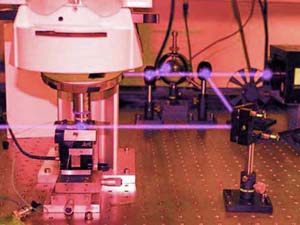
[>img(45%+,)[Optics|images/opticsetup.jpg]]
Coming from the ''Physics of Complex Systems'', we seek properties which display a degree of universality, rather than step by step descriptions of system specific processes (for an application of this philosophy in a rather different context see the project “Shape of Clouds”). Where it exists, such ''universality'' usually translates into a simple mathematical description.
For example, carefully measuring the elastic energy of a short DNA molecule under stress we found a bifurcation analogous to the buckling of a macroscopic stick (the Euler instability). DNA bending elasticity in the linear and nonlinear regimes is now described by a simple analytic expression.
[<img(35%+,)[Chimera|images/chimera1.png]]
Similarly, we are interested in controlling proteins, not by mutagenesis, which is system specific, but mechanically instead, where universal behavior may emerge. One mechanical component which, unlike nuts and bolts, can be shrunk to the nanoscale is the spring. By inserting a “molecular spring” on a protein we control the protein’s conformation, and thus its activity.
We create artificial molecular devices based on allosteric control. We try to approach nanotechnology from a fundamental science perspective.
Another example is the mechanical (“rheological”) properties of the folded state of proteins, which may show universal behavior. We developed a nanotechnology method which probes deformations of the folded state with sub-Angstrom resolution, and discovered that the folded protein is viscoelastic. This is a fundamental materials property of the protein molecule, and may allow new insight into mechano-chemical processes in these molecules.
''DNA'' is the molecule which encodes the masterplan for the cell. Decoding this information, i.e. the process of expressing and controlling genes, involves a variety of conformational changes of DNA caused by protein - DNA interactions.
''Proteins'' are the molecular machines which perform the tasks in the living cell. This includes catalysis, molecular recognition, and mechanical motion. Virtually all these tasks involve a change of conformation of the protein. ''Allosteric control'', whereby a chemical signal modifies a protein’s conformation, is the molecular basis of life.
<html>
<center>
<font size="2">
Research in the Zocchi Lab has been supported by:
<br>
The National Science Foundation / DMR; The US-Israel Binational Science Foundation; The US Department of Defense / DMEA
<br>
and is currently supported by:
<br>
The UC Lab Research Program; The National Science Foundation / DMR
</font>
</center>
</html>
[<img(,600px)[images/proj_cloud_1.gif][]]
This is the velocity field of a thermal plume.
/***
|Name|ImageSizePlugin|
|Source|http://www.TiddlyTools.com/#ImageSizePlugin|
|Version|1.2.2|
|Author|Eric Shulman|
|License|http://www.TiddlyTools.com/#LegalStatements|
|~CoreVersion|2.1|
|Type|plugin|
|Description|adds support for resizing images|
This plugin adds optional syntax to scale an image to a specified width and height and/or interactively resize the image with the mouse.
!!!!!Usage
<<<
The extended image syntax is:
{{{
[img(w+,h+)[...][...]]
}}}
where ''(w,h)'' indicates the desired width and height (in CSS units, e.g., px, em, cm, in, or %). Use ''auto'' (or a blank value) for either dimension to scale that dimension proportionally (i.e., maintain the aspect ratio). You can also calculate a CSS value 'on-the-fly' by using a //javascript expression// enclosed between """{{""" and """}}""". Appending a plus sign (+) to a dimension enables interactive resizing in that dimension (by dragging the mouse inside the image). Use ~SHIFT-click to show the full-sized (un-scaled) image. Use ~CTRL-click to restore the starting size (either scaled or full-sized).
<<<
!!!!!Examples
<<<
{{{
[img(100px+,75px+)[images/meow2.jpg]]
}}}
[img(100px+,75px+)[images/meow2.jpg]]
{{{
[<img(34%+,+)[images/meow.gif]]
[<img(21% ,+)[images/meow.gif]]
[<img(13%+, )[images/meow.gif]]
[<img( 8%+, )[images/meow.gif]]
[<img( 5% , )[images/meow.gif]]
[<img( 3% , )[images/meow.gif]]
[<img( 2% , )[images/meow.gif]]
[img( 1%+,+)[images/meow.gif]]
}}}
[<img(34%+,+)[images/meow.gif]]
[<img(21% ,+)[images/meow.gif]]
[<img(13%+, )[images/meow.gif]]
[<img( 8%+, )[images/meow.gif]]
[<img( 5% , )[images/meow.gif]]
[<img( 3% , )[images/meow.gif]]
[<img( 2% , )[images/meow.gif]]
[img( 1%+,+)[images/meow.gif]]
{{tagClear{
}}}
<<<
!!!!!Revisions
<<<
2010.07.24 [1.2.2] moved tip/dragtip text to config.formatterHelpers.imageSize object to enable customization
2009.02.24 [1.2.1] cleanup width/height regexp, use '+' suffix for resizing
2009.02.22 [1.2.0] added stretchable images
2008.01.19 [1.1.0] added evaluated width/height values
2008.01.18 [1.0.1] regexp for "(width,height)" now passes all CSS values to browser for validation
2008.01.17 [1.0.0] initial release
<<<
!!!!!Code
***/
//{{{
version.extensions.ImageSizePlugin= {major: 1, minor: 2, revision: 2, date: new Date(2010,7,24)};
//}}}
//{{{
var f=config.formatters[config.formatters.findByField("name","image")];
f.match="\\[[<>]?[Ii][Mm][Gg](?:\\([^,]*,[^\\)]*\\))?\\[";
f.lookaheadRegExp=/\[([<]?)(>?)[Ii][Mm][Gg](?:\(([^,]*),([^\)]*)\))?\[(?:([^\|\]]+)\|)?([^\[\]\|]+)\](?:\[([^\]]*)\])?\]/mg;
f.handler=function(w) {
this.lookaheadRegExp.lastIndex = w.matchStart;
var lookaheadMatch = this.lookaheadRegExp.exec(w.source)
if(lookaheadMatch && lookaheadMatch.index == w.matchStart) {
var floatLeft=lookaheadMatch[1];
var floatRight=lookaheadMatch[2];
var width=lookaheadMatch[3];
var height=lookaheadMatch[4];
var tooltip=lookaheadMatch[5];
var src=lookaheadMatch[6];
var link=lookaheadMatch[7];
// Simple bracketted link
var e = w.output;
if(link) { // LINKED IMAGE
if (config.formatterHelpers.isExternalLink(link)) {
if (config.macros.attach && config.macros.attach.isAttachment(link)) {
// see [[AttachFilePluginFormatters]]
e = createExternalLink(w.output,link);
e.href=config.macros.attach.getAttachment(link);
e.title = config.macros.attach.linkTooltip + link;
} else
e = createExternalLink(w.output,link);
} else
e = createTiddlyLink(w.output,link,false,null,w.isStatic);
addClass(e,"imageLink");
}
var img = createTiddlyElement(e,"img");
if(floatLeft) img.align="left"; else if(floatRight) img.align="right";
if(width||height) {
var x=width.trim(); var y=height.trim();
var stretchW=(x.substr(x.length-1,1)=='+'); if (stretchW) x=x.substr(0,x.length-1);
var stretchH=(y.substr(y.length-1,1)=='+'); if (stretchH) y=y.substr(0,y.length-1);
if (x.substr(0,2)=="{{")
{ try{x=eval(x.substr(2,x.length-4))} catch(e){displayMessage(e.description||e.toString())} }
if (y.substr(0,2)=="{{")
{ try{y=eval(y.substr(2,y.length-4))} catch(e){displayMessage(e.description||e.toString())} }
img.style.width=x.trim(); img.style.height=y.trim();
config.formatterHelpers.addStretchHandlers(img,stretchW,stretchH);
}
if(tooltip) img.title = tooltip;
// GET IMAGE SOURCE
if (config.macros.attach && config.macros.attach.isAttachment(src))
src=config.macros.attach.getAttachment(src); // see [[AttachFilePluginFormatters]]
else if (config.formatterHelpers.resolvePath) { // see [[ImagePathPlugin]]
if (config.browser.isIE || config.browser.isSafari) {
img.onerror=(function(){
this.src=config.formatterHelpers.resolvePath(this.src,false);
return false;
});
} else
src=config.formatterHelpers.resolvePath(src,true);
}
img.src=src;
w.nextMatch = this.lookaheadRegExp.lastIndex;
}
}
config.formatterHelpers.imageSize={
tip: 'SHIFT-CLICK=show full size, CTRL-CLICK=restore initial size',
dragtip: 'DRAG=stretch/shrink, '
}
config.formatterHelpers.addStretchHandlers=function(e,stretchW,stretchH) {
e.title=((stretchW||stretchH)?this.imageSize.dragtip:'')+this.imageSize.tip;
e.statusMsg='width=%0, height=%1';
e.style.cursor='move';
e.originalW=e.style.width;
e.originalH=e.style.height;
e.minW=Math.max(e.offsetWidth/20,10);
e.minH=Math.max(e.offsetHeight/20,10);
e.stretchW=stretchW;
e.stretchH=stretchH;
e.onmousedown=function(ev) { var ev=ev||window.event;
this.sizing=true;
this.startX=!config.browser.isIE?ev.pageX:(ev.clientX+findScrollX());
this.startY=!config.browser.isIE?ev.pageY:(ev.clientY+findScrollY());
this.startW=this.offsetWidth;
this.startH=this.offsetHeight;
return false;
};
e.onmousemove=function(ev) { var ev=ev||window.event;
if (this.sizing) {
var s=this.style;
var currX=!config.browser.isIE?ev.pageX:(ev.clientX+findScrollX());
var currY=!config.browser.isIE?ev.pageY:(ev.clientY+findScrollY());
var newW=(currX-this.offsetLeft)/(this.startX-this.offsetLeft)*this.startW;
var newH=(currY-this.offsetTop )/(this.startY-this.offsetTop )*this.startH;
if (this.stretchW) s.width =Math.floor(Math.max(newW,this.minW))+'px';
if (this.stretchH) s.height=Math.floor(Math.max(newH,this.minH))+'px';
clearMessage(); displayMessage(this.statusMsg.format([s.width,s.height]));
}
return false;
};
e.onmouseup=function(ev) { var ev=ev||window.event;
if (ev.shiftKey) { this.style.width=this.style.height=''; }
if (ev.ctrlKey) { this.style.width=this.originalW; this.style.height=this.originalH; }
this.sizing=false;
clearMessage();
return false;
};
e.onmouseout=function(ev) { var ev=ev||window.event;
this.sizing=false;
clearMessage();
return false;
};
}
//}}}
!!Physics M215D: Nonequilibrium Statistical Mechanics and Molecular Biophysics (Part A)
!!!!Course Information
|Instructor: |Giovanni Zocchi |
|Office: |3-124 Knudsen; |
|Phone: |(310) 825-4018; |
|Lab: |PAB A-425, A-429; |
|Phone: |(310) 206-0715 |
|E-mail: |zocchi@physics.ucla.edu |
|Office hours: |by appointment. |
|Time and location: |Tues. & Thu. 12:30-2:00 in Knudsen 6-107. |
|Textbook: |K. Sneppen and G. Zocchi: Physics in Molecular Biology (Cambridge 2005). |
|Grading: |based on the presentation of a paper in the literature |f
!!!!Approximate lecture schedule
|!Week |!Lecture Description |h
|1 |Molecular interactions. Osmotic pressure; depletion forces; electrostatics in water; hydrophobic interaction; hydrogen bonds; Van der Waals forces. |
|2 |Polymer Physics (chapter 2). |
|3-4 |DNA (chapter 3). DNA structure; recombinant DNA technology; phase transitions in DNA (DNA melting): models & experiments. |
|5 |Protein structure and protein folding (chapters 4, 5). |
|6-7 |Conformational transitions in proteins. Allosteric networks; nanotechnology approach to artificial allostery. |
|8-9 |Genetic regulation: the λ-phage in E. coli (chapter 7) |
|10 |Models of evolution (chapter 9). |
!!!!Lecture Notes (pdf)
> [[Molecular Interactions_A|files/*.pdf]]
> [[Osmotic pressure & depletion forces|files/*.pdf]]
> [[Electrostatics in water|files/*.pdf]]
> [[Molecular Interactions_B|files/*.pdf]]
> [[Polymers|files/*.pdf]]
> [[DNA structure|files/*.pdf]]
> [[Protein structure|files/*.pdf]]
> [[Genetic regulation|files/*.pdf]]
!!Useful External Links:
|!Links |!Descriptions |h
|[[Oligo Calculator|http://www.pitt.edu/%7Ersup/OligoCalc.html]] |Calculate the melting temperature of the primer that you're trying to design |
|[[Unit Conversion|http://www.unit-conversion.info/]] |Converts units such as length, temperature, energy, and even curreny |
|[[Quikchange Primer Tm|http://www.stratagene.com/QPCR/tmCalc.aspx]] |Stratagene Primer Calculator |
|[[Restriction Sites Locator|http://rna.lundberg.gu.se/cutter2/index.html]] |Locate Restriction Sites of your DNA sequences with Webcutter 2.0 |
|[[DNA Sequencing|http://www.genoseq.ucla.edu/action/view/Sequencing]] |UCLA Sequencing & Genotyping Core (Gonda Center Rm. 5309) |
|[[Sequence Alignment|http://www.ebi.ac.uk/Tools/emboss/align/]] |EMBOSS Pairwise Alignment Algorithms (more tools at EMBL-EBI) |
|[[Protein Data Bank|http://www.rcsb.org/pdb/]] |Database of 3D macromolecule structures solved by X-ray or NMR |
Welcome to
[[Zocchi's Lab|Home]]
----
People
[[Current Members]]
[[Former Members]]
----
Projects
[[Current Projects]]
[[Past Projects]]
----
[[Publications]]
----
[[Contact]]
[[Lectures]]
[[MISC]]
----
<<search>>
----
<html> <p style="font-size:11px">Last Updated: 05/18/2011 <br/>
Copyright (c) Zocchi's Lab 2008-2011</p></html>
//Brian Choi//
Protein Kinases are enzymes which phosphorylate protein substrates, and are typically involved in signal transduction. Protein Kinase A (PKA) in particular plays a crucial role in numerous signaling pathways and metabolic processes. PKA is allosterically regulated by cAMP; it is in fact the primary receptor for cAMP in eukaryotic cells. The tetrameric enzyme, composed of two regulatory (RS) and two catalytic (CS) subunits, is inactive, because the RS binds to the CS through a surface of contact which includes the catalytic site, which is thus not accessible in this state. Upon cAMP binding the RS undergoes a conformational change which causes the CS to dissociate from the complex, activating catalysis. Part of this conformational change consists of the relative displacement of the red α-helices displayed in the Figure below.
The aim of this project is to study this allosteric mechanism by mechanically forcing conformational changes of the RS which elicit dissociation of the CS. We have shown that directly applying the mechanical stress on two elements of the protein’s secondary structure which are known to move with respect to each other in the cAMP-induced conformational change indeed activates the complex, roughly as effectively as the presence of cAMP. The mechanical stress is exerted by a “molecular spring” made of a short piece of DNA, which we chemically couple to the regulatory subunit by attaching the ends of the DNA to Cysteine residues introduced at specific locations by site directed mutagenesis. The stiffness of the DNA spring can be varied externally by hybridization with complementary DNA of varying lengths, providing external control over the mechanical stress.
[>img(45%,)[images/PKA.png][]]
//The cAMP-induced conformational change of the regulatory subunit (RS: green) consists in part of a relative displacement of the two red α-helices. We directly apply a mechanical stress to the RS which favors this conformational motion, by attaching a molecular spring to the two helices. Under tension (lower part of the Figure), the spring pulls the helices apart. We obtain dissociation of the catalytic subunit (CS: blue) and consequently activation of the enzyme. //
*B. Choi and G. Zocchi, “Mimicking cAMP Dependent Allosteric Control of Protein Kinase A through Mechanical Tension”, JACS 128, 8541-48 (2006).
[[Yong Wang]]
Biological macromolecules are structurally ordered but “soft”. This is a result of the two different energy scales embedded in the molecule: the covalent bonds which form the polymer, and the non-covalent interactions “transverse” to the polymer backbone (hydrogen bonds, hydrophobic interaction, etc.), which are roughly 100 times weaker. The mechanical properties of such a structure must be peculiar. In addition, the mechanics of these molecules is tightly coupled to their function, as molecular recognition, catalysis and regulation all depend on conformational motion.
We have developed a method to investigate the mechanical properties of the //folded// state of globular proteins, based on measuring the AC mechanical susceptibility.
|borderless|k
|[<img(220px,)[images/proj_nanorheology_1.png]] | [img(280px,)[images/EMW.png]]|
|~|''Schematics of the sample and apparatus to measure the AC susceptibility of proteins. The stress on the sample is applied through gold nanoparticles driven by an oscillating electric field; the strain is obtained from the displacement of the gold particles, measured by evanescent wave scattering.''|
The molecule under study is used to tether gold nanoparticles to the surface of a microscope slide coated with a thin layer of gold; the purpose of this layer is to obtain a conducting electrode, and also take advantage of the affinity of thiol groups (which can be introduced into proteins and DNA) for gold surfaces. The layer is thin in order to allow optical measurements. The experiment consists in mechanically driving the gold nanoparticles using an AC electric field and detecting their motion transverse to the slide by evanescent wave scattering, in a phase locked loop. The amplitude and phase of the particles’ displacement, averaged over many particles, are recorded in the frequency range 10 Hz – 10 kHz; these curves contain the information about the mechanical properties of the protein. One can measure response amplitudes down to a fraction of an Angstrom, and thus probe the folded state of the protein (in contrast to AFM pulling experiments, which probe the unfolding process). [<img(390px,)[images/proj_nanorheology_res1.png]] For instance, the figure below shows the stiffening of the enzyme Guanylate Kinase upon binding a substrate (GMP).
''Amplitude of the response vs frequency for a Guanylate Kinase sample in the absence (black) and presence (red) of the substrate GMP. The protein stiffens when binding the substrate.''
Using this technique, we discovered that the folded protein is a visco-elastic solid. For low driving amplitudes, the response is elastic, as in the figure above; for larger forcing, there is a (reversible) transition to visco-elasticity, shown below, where the system behaves like a spring at high frequencies, but flows like a viscous fluid at low frequencies. [>img(390px,)[images/proj_nanorheology_res2.png]]
''Transition from elastic (black data; low driving force) to visco-elastic (red data; higher driving force) response for Guanylate Kinase as the driving force is increased. ''
There is presumably a degree of universality to this mechanical behavior for proteins, and therefore interesting questions to ask about this transition to visco-elasticity.
* Y. Wang and G. Zocchi, Elasticity of globular proteins measured from the AC susceptibility, //Phys. Rev. Lett.// ''105'' 238104 (2010). [img[images/ieicon.jpg][http://prl.aps.org/abstract/PRL/v105/i23/e238104]] [img[images/pdficon.jpg][http://prl.aps.org/pdf/PRL/v105/i23/e238104]]
* Y. Wang and G. Zocchi, The Protein as a Viscoelastic Solid, //submitted//, (2011).
[[Elastic Energy Driven Self-Assembly]]
[[Dynamics of conformational changes in DNA]]
[[Mimicking cAMP dependent Allostery of PKA]]
[[Artificial Allosteric Control of Maltose Binding Protein]]
[[Dynamics of Protein-DNA interactions]]
[[Statistical Mechanics of DNA melting]]
[[Single Molecule Detection of DNA Hybridization]]
[[Bubbles in DNA]]
[[Plasticity of proteins]]
[[Depletion Forces with Albumin]]
[[Single Molecule Experiments by Evanescent Wave Scattering]]
//Mukta Singh-Zocchi , Jeungphill Hanne//
Globular proteins are peculiar solids that display both local stability of their conformation and the ability to undergo large cooperative changes of shape (conformational changes). If one forces a large deformation of the molecule, such that the structure is necessarily changed, it is not obvious whether the deformed globule can still remain a solid or whether it will melt. Is it possible to plastically deform a protein? We investigate this question with a micro-mechanical experiment on a small region (~ 10 molecules) of a protein monolayer adsorbed on a rigid surface. For the two proteins studied, albumin and myoglobin, we observed that the molecules can be substantially deformed (~ 1–2 nm deformation) by comparatively small stresses applied for sufficiently long times. The deformation is irreversible, and the protein remains in the solid state (i.e., displays a nonzero shear modulus). The dynamics of the deformation is approximately logarithmic in time, similar to creep in solids. These results show that globular proteins adsorbed on a surface can be plastically deformed.
[>img(45%,)[images/plasticity.png][]]
//Slow dynamics in the mechanical compression of albumin monolayers. The figure shows the time course of the separation between the bead and the slide. The vertical scale is in nanometers, and h = 0 corresponds to the albumin layers coming into contact. The initial condition is with the sphere in the secondary minimum of the DLVO potential, at h = 10 nm (not visible in the figure). At t = 40 s, solution A (low ionic strength) is exchanged with solution B (high ionic strength), and the sphere falls into the primary minimum (sharp vertical line close to t = 0). From then on a slow deformation sets in, with a total amplitude of 3 nm over the 30 min of the experiment. The dashed line is a power law fit.
(B) The same data as in A plotted versus log (t). The solid line is drawn to show that the plot is roughly linear. //
*M. Singh-Zocchi, J. Hanne, and G. Zocchi, “Plastic deformation of protein layers”, Biophys. J. 83, 2211-18 (2002).
/***
|Name|PlayerPlugin|
|Source|http://www.TiddlyTools.com/#PlayerPlugin|
|Version|1.1.4|
|Author|Eric Shulman|
|License|http://www.TiddlyTools.com/#LegalStatements|
|~CoreVersion|2.1|
|Type|plugin|
|Description|Embed a media player in a tiddler|
!!!!!Usage
<<<
{{{<<player [id=xxx] [type] [URL] [width] [height] [autoplay|true|false] [showcontrols|true|false] [extras]>>}}}
''id=xxx'' is optional, and specifies a unique identifier for each embedded player. note: this is required if you intend to display more than one player at the same time.
''type'' is optional, and is one of the following: ''windows'', ''realone'', ''quicktime'', ''flash'', ''image'' or ''iframe''. If the media type is not specified, the plugin automatically detects Windows, Real, QuickTime, Flash video or JPG/GIF images by matching known file extensions and/or specialized streaming-media transfer protocols (such as RTSP:). For unrecognized media types, the plugin displays an error message.
''URL'' is the location of the media content
''width'' and ''height'' are the dimensions of the video display area (in pixels)
''autoplay'' or ''true'' or ''false'' is optional, and specifies whether the media content should begin playing as soon as it is loaded, or wait for the user to press the "play" button. Default is //not// to autoplay.
''showcontrols'' or ''true'' or ''false'' is optional, and specifies whether the embedded media player should display its built-in control panel (e.g., play, pause, stop, rewind, etc), if any. Default is to display the player controls.
''extras'' are optional //pairs// of parameters that can be passed to the embedded player, using the {{{<param name=xxx value=yyy>}}} HTML syntax.
''If you use [[AttachFilePlugin]] to encode and store a media file within your document, you can play embedded media content by using the title of the //attachment tiddler//'' as a parameter in place of the usual reference to an external URL. When playing an attached media content, you should always explicitly specify the media type parameter, because the name used for the attachment tiddler may not contain a known file extension from which a default media type can be readily determined.
<<<
!!!!!Configuration
<<<
Default player size:
width: <<option txtPlayerDefaultWidth>> height: <<option txtPlayerDefaultHeight>>
<<<
!!!!!Examples
<<<
+++[Windows Media]...
Times Square Live Webcam
{{{<<player id=1 http://www.earthcam.com/usa/newyork/timessquare/asx/tsq_stream.asx>>}}}
<<player id=1 http://www.earthcam.com/usa/newyork/timessquare/asx/tsq_stream.asx>>
===
+++[RealOne]...
BBC London: Live and Recorded news
{{{<<player id=2 http://www.bbc.co.uk/london/realmedia/news/tvnews.ram>>}}}
<<player id=2 http://www.bbc.co.uk/london/realmedia/news/tvnews.ram>>
===
+++[Quicktime]...
America Free TV: Classic Comedy
{{{<<player id=3 http://www.americafree.tv/unicast_mov/AmericaFreeTVComedy.mov>>}}}
<<player id=3 http://www.americafree.tv/unicast_mov/AmericaFreeTVComedy.mov>>
===
+++[Flash]...
Asteroids arcade game
{{{<<player id=4 http://www.80smusiclyrics.com/games/asteroids/asteroids.swf 400 300>>}}}
<<player id=4 http://www.80smusiclyrics.com/games/asteroids/asteroids.swf 400 300>>
Google Video
{{{<<player id=5 flash http://video.google.com/googleplayer.swf?videoUrl=http%3A%2F%2Fvp.video.google.com%2Fvideodownload%3Fversion%3D0%26secureurl%3DoQAAAIVnUNP6GYRY8YnIRNPe4Uk5-j1q1MVpJIW4uyEFpq5Si0hcSDuig_JZcB9nNpAhbScm9W_8y_vDJQBw1DRdCVbXl-wwm5dyUiiStl_rXt0ATlstVzrUNC4fkgK_j7nmse7kxojRj1M3eo3jXKm2V8pQjWk97GcksMFFwg7BRAXmRSERexR210Amar5LYzlo9_k2AGUWPLyRhMJS4v5KtDSvNK0neL83ZjlHlSECYXyk%26sigh%3Dmpt2EOr86OAUNnPQ3b9Tr0wnDms%26begin%3D0%26len%3D429700%26docid%3D-914679554478687740&thumbnailUrl=http%3A%2F%2Fvideo.google.com%2FThumbnailServer%3Fcontentid%3De7e77162deb04c42%26second%3D5%26itag%3Dw320%26urlcreated%3D1144620753%26sigh%3DC3fqXPPS1tFiUqLzmkX3pdgYc2Y&playerId=-91467955447868774 400 326>>}}}
<<player id=5 flash http://video.google.com/googleplayer.swf?videoUrl=http%3A%2F%2Fvp.video.google.com%2Fvideodownload%3Fversion%3D0%26secureurl%3DoQAAAIVnUNP6GYRY8YnIRNPe4Uk5-j1q1MVpJIW4uyEFpq5Si0hcSDuig_JZcB9nNpAhbScm9W_8y_vDJQBw1DRdCVbXl-wwm5dyUiiStl_rXt0ATlstVzrUNC4fkgK_j7nmse7kxojRj1M3eo3jXKm2V8pQjWk97GcksMFFwg7BRAXmRSERexR210Amar5LYzlo9_k2AGUWPLyRhMJS4v5KtDSvNK0neL83ZjlHlSECYXyk%26sigh%3Dmpt2EOr86OAUNnPQ3b9Tr0wnDms%26begin%3D0%26len%3D429700%26docid%3D-914679554478687740&thumbnailUrl=http%3A%2F%2Fvideo.google.com%2FThumbnailServer%3Fcontentid%3De7e77162deb04c42%26second%3D5%26itag%3Dw320%26urlcreated%3D1144620753%26sigh%3DC3fqXPPS1tFiUqLzmkX3pdgYc2Y&playerId=-91467955447868774 400 326>>
YouTube Video
{{{<<player id=6 flash http://www.youtube.com/v/OdT9z-JjtJk 400 300>>}}}
<<player id=6 flash http://www.youtube.com/v/OdT9z-JjtJk 400 300>>
===
+++[Still Images]...
GIF (best for illustrations, animations, diagrams, etc.)
{{{<<player id=7 image images/meow.gif auto auto>>}}}
<<player id=7 image images/meow.gif auto auto>>
JPG (best for photographs, scanned images, etc.)
{{{<<player id=8 image images/meow2.jpg 200 150>>}}}
<<player id=8 image images/meow2.jpg 200 150>>
===
<<<
!!!!!Revisions
<<<
2008.05.10 [1.1.4] in handlers(), immediately return if no params (prevents error in macro). Also, refactored auto-detect code to make type mapping configurable.
2007.10.15 [1.1.3] in loadURL(), add recognition for .PNG (still image), fallback to iframe for unrecognized media types
2007.08.31 [1.1.2] added 'click-through' link for JPG/GIF images
2007.06.21 [1.1.1] changed "hidecontrols" param to "showcontrols" and recognize true/false values in addition to 'showcontrols', added "autoplay" param (also recognize true/false values), allow "auto" as value for type param
2007.05.22 [1.1.0] added support for type=="iframe" (displays src URL in an IFRAME)
2006.12.06 [1.0.1] in handler(), corrected check for config.macros.attach (instead of config.macros.attach.getAttachment) so that player plugin will work when AttachFilePlugin is NOT installed. (Thanks to Phillip Ehses for bug report)
2006.11.30 [1.0.0] support embedded media content using getAttachment() API defined by AttachFilePlugin or AttachFilePluginFormatters. Also added support for 'image' type to render JPG/GIF still images
2006.02.26 [0.7.0] major re-write. handles default params better. create/recreate player objects via loadURL() API for use with interactive forms and scripts.
2006.01.27 [0.6.0] added support for 'extra' macro params to pass through to object parameters
2006.01.19 [0.5.0] Initial ALPHA release
2005.12.23 [0.0.0] Started
<<<
!!!!!Code
***/
//{{{
version.extensions.PlayerPlugin= {major: 1, minor: 1, revision: 4, date: new Date(2008,5,10)};
config.macros.player = {};
config.macros.player.html = {};
config.macros.player.handler= function(place,macroName,params) {
if (!params.length) return; // missing parameters - do nothing
var id=null;
if (params[0].substr(0,3)=="id=") id=params.shift().substr(3);
var type="";
if (!params.length) return; // missing parameters - do nothing
var p=params[0].toLowerCase();
if (p=="auto" || p=="windows" || p=="realone" || p=="quicktime" || p=="flash" || p=="image" || p=="iframe")
type=params.shift().toLowerCase();
var url=params.shift(); if (!url || !url.trim().length) url="";
if (url.length && config.macros.attach!=undefined) // if AttachFilePlugin is installed
if ((tid=store.getTiddler(url))!=null && tid.isTagged("attachment")) // if URL is attachment
url=config.macros.attach.getAttachment(url); // replace TiddlerTitle with URL
var width=params.shift();
var height=params.shift();
var autoplay=false;
if (params[0]=='autoplay'||params[0]=='true'||params[0]=='false')
autoplay=(params.shift()!='false');
var show=true;
if (params[0]=='showcontrols'||params[0]=='true'||params[0]=='false')
show=(params.shift()!='false');
var extras="";
while (params[0]!=undefined)
extras+="<param name='"+params.shift()+"' value='"+params.shift()+"'> ";
this.loadURL(place,id,type,url,width,height,autoplay,show,extras);
}
if (config.options.txtPlayerDefaultWidth==undefined) config.options.txtPlayerDefaultWidth="100%";
if (config.options.txtPlayerDefaultHeight==undefined) config.options.txtPlayerDefaultHeight="480"; // can't use "100%"... player height doesn't stretch right :-(
config.macros.player.typeMap={
windows: ['mms', '.asx', '.wvx', '.wmv', '.mp3'],
realone: ['rtsp', '.ram', '.rpm', '.rm', '.ra'],
quicktime: ['.mov', '.qt'],
flash: ['.swf', '.flv'],
image: ['.jpg', '.gif', '.png'],
iframe: ['.htm', '.html', '.shtml', '.php']
};
config.macros.player.loadURL=function(place,id,type,url,width,height,autoplay,show,extras) {
if (id==undefined) id="tiddlyPlayer";
if (!width) var width=config.options.txtPlayerDefaultWidth;
if (!height) var height=config.options.txtPlayerDefaultHeight;
if (url && (!type || !type.length || type=="auto")) { // determine type from URL
u=url.toLowerCase();
var map=config.macros.player.typeMap;
for (var t in map) for (var i=0; i<map[t].length; i++)
if (u.indexOf(map[t][i])!=-1) var type=t;
}
if (!type || !config.macros.player.html[type]) var type="none";
if (!url) var url="";
if (show===undefined) var show=true;
if (!extras) var extras="";
if (type=="none" && url.trim().length) type="iframe"; // fallback to iframe for unrecognized media types
// adjust parameter values for player-specific embedded HTML
switch (type) {
case "windows":
autoplay=autoplay?"1":"0"; // player-specific param value
show=show?"1":"0"; // player-specific param value
break;
case "realone":
autoplay=autoplay?"true":"false";
show=show?"block":"none";
height-=show?60:0; // leave room for controls
break;
case "quicktime":
autoplay=autoplay?"true":"false";
show=show?"true":"false";
break;
case "image":
show=show?"block":"none";
break;
case "iframe":
show=show?"block":"none";
break;
}
// create containing div for player HTML
// and add or replace player in TW DOM structure
var newplayer = document.createElement("div");
newplayer.playerType=type;
newplayer.setAttribute("id",id+"_div");
var existing = document.getElementById(id+"_div");
if (existing && !place) place=existing.parentNode;
if (!existing)
place.appendChild(newplayer);
else {
if (place==existing.parentNode) place.replaceChild(newplayer,existing)
else { existing.parentNode.removeChild(existing); place.appendChild(newplayer); }
}
var html=config.macros.player.html[type];
html=html.replace(/%i%/mg,id);
html=html.replace(/%w%/mg,width);
html=html.replace(/%h%/mg,height);
html=html.replace(/%u%/mg,url);
html=html.replace(/%a%/mg,autoplay);
html=html.replace(/%s%/mg,show);
html=html.replace(/%x%/mg,extras);
newplayer.innerHTML=html;
}
//}}}
// // Player-specific API functions: isReady(id), isPlaying(id), toggleControls(id), showControls(id,flag)
//{{{
// status values:
// Windows: 0=Undefined, 1=Stopped, 2=Paused, 3=Playing, 4=ScanForward, 5=ScanReverse
// 6=Buffering, 7=Waiting, 8=MediaEnded, 9=Transitioning, 10=Ready, 11=Reconnecting
// RealOne: 0=Stopped, 1=Contacting, 2=Buffering, 3=Playing, 4=Paused, 5=Seeking
// QuickTime: 'Waiting', 'Loading', 'Playable', 'Complete', 'Error:###'
// Flash: 0=Loading, 1=Uninitialized, 2=Loaded, 3=Interactive, 4=Complete
config.macros.player.isReady=function(id)
{
var d=document.getElementById(id+"_div"); if (!d) return false;
var p=document.getElementById(id); if (!p) return false;
if (d.playerType=='windows') return !((p.playState==0)||(p.playState==7)||(p.playState==9)||(p.playState==11));
if (d.playerType=='realone') return (p.GetPlayState()>1);
if (d.playerType=='quicktime') return !((p.getPluginStatus()=='Waiting')||(p.getPluginStatus()=='Loading'));
if (d.playerType=='flash') return (p.ReadyState>2);
return true;
}
config.macros.player.isPlaying=function(id)
{
var d=document.getElementById(id+"_div"); if (!d) return false;
var p=document.getElementById(id); if (!p) return false;
if (d.playerType=='windows') return (p.playState==3);
if (d.playerType=='realone') return (p.GetPlayState()==3);
if (d.playerType=='quicktime') return (p.getPluginStatus()=='Complete');
if (d.playerType=='flash') return (p.ReadyState<4);
return false;
}
config.macros.player.showControls=function(id,flag) {
var d=document.getElementById(id+"_div"); if (!d) return false;
var p=document.getElementById(id); if (!p) return false;
if (d.playerType=='windows') { p.ShowControls=flag; p.ShowStatusBar=flag; }
if (d.playerType=='realone') { alert('show/hide controls not available'); }
if (d.playerType=='quicktime') // if player not ready, retry in one second
{ if (this.isReady(id)) p.setControllerVisible(flag); else setTimeout('config.macros.player.showControls("'+id+'",'+flag+')',1000); }
if (d.playerType=='flash') { alert('show/hide controls not available'); }
}
config.macros.player.toggleControls=function(id) {
var d=document.getElementById(id+"_div"); if (!d) return false;
var p=document.getElementById(id); if (!p) return false;
if (d.playerType=='windows') var flag=!p.ShowControls;
if (d.playerType=='realone') var flag=true; // TBD
if (d.playerType=='quicktime') var flag=!p.getControllerVisible();
if (d.playerType=='flash') var flag=true; // TBD
this.showControls(id,flag);
}
config.macros.player.fullScreen=function(id) {
var d=document.getElementById(id+"_div"); if (!d) return false;
var p=document.getElementById(id); if (!p) return false;
if (d.playerType=='windows') p.DisplaySize=3;
if (d.playerType=='realone') p.SetFullScreen();
if (d.playerType=='quicktime') { alert('full screen not available'); }
if (d.playerType=='flash') { alert('full screen not available'); }
}
//}}}
// // Player HTML
//{{{
// placeholder (no player)
config.macros.player.html.none=' \
<table id="%i%" width="%w%" height="%h%" style="background-color:#111;border:0;margin:0;padding:0;"> \
<tr style="background-color:#111;border:0;margin:0;padding:0;"> \
<td width="%w%" height="%h%" style="background-color:#111;color:#ccc;border:0;margin:0;padding:0;text-align:center;"> \
\
%u% \
\
</td></tr></table>';
//}}}
//{{{
// JPG/GIF/PNG still images
config.macros.player.html.image='\
<a href="%u%" target="_blank"><img width="%w%" height="%h%" style="display:%s%;" src="%u%"></a>';
//}}}
//{{{
// IFRAME web page viewer
config.macros.player.html.iframe='\
<iframe id="%i%" width="%w%" height="%h%" style="display:%s%;background:#fff;" src="%u%"></iframe>';
//}}}
//{{{
// Windows Media Player
// v7.1 ID: classid=CLSID:6BF52A52-394A-11d3-B153-00C04F79FAA6
// v9 ID: classid=CLSID:22d6f312-b0f6-11d0-94ab-0080c74c7e95
config.macros.player.html.windows=' \
<object id="%i%" width="%w%" height="%h%" style="margin:0;padding:0;width:%w%;height:%h%px;" \
classid="CLSID:22d6f312-b0f6-11d0-94ab-0080c74c7e95" \
codebase="http://activex.microsoft.com/activex/controls/mplayer/en/nsmp2inf.cab#Version=6,4,5,715" \
align="baseline" border="0" \
standby="Loading Microsoft Windows Media Player components..." \
type="application/x-oleobject"> \
<param name="FileName" value="%u%"> <param name="ShowControls" value="%s%"> \
<param name="ShowPositionControls" value="1"> <param name="ShowAudioControls" value="1"> \
<param name="ShowTracker" value="1"> <param name="ShowDisplay" value="0"> \
<param name="ShowStatusBar" value="1"> <param name="AutoSize" value="1"> \
<param name="ShowGotoBar" value="0"> <param name="ShowCaptioning" value="0"> \
<param name="AutoStart" value="%a%"> <param name="AnimationAtStart" value="1"> \
<param name="TransparentAtStart" value="0"> <param name="AllowScan" value="1"> \
<param name="EnableContextMenu" value="1"> <param name="ClickToPlay" value="1"> \
<param name="InvokeURLs" value="1"> <param name="DefaultFrame" value="datawindow"> \
%x% \
<embed src="%u%" style="margin:0;padding:0;width:%w%;height:%h%px;" \
align="baseline" border="0" width="%w%" height="%h%" \
type="application/x-mplayer2" \
pluginspage="http://www.microsoft.com/windows/windowsmedia/download/default.asp" \
name="%i%" showcontrols="%s%" showpositioncontrols="1" \
showaudiocontrols="1" showtracker="1" showdisplay="0" \
showstatusbar="%s%" autosize="1" showgotobar="0" showcaptioning="0" \
autostart="%a%" autorewind="0" animationatstart="1" transparentatstart="0" \
allowscan="1" enablecontextmenu="1" clicktoplay="0" invokeurls="1" \
defaultframe="datawindow"> \
</embed> \
</object>';
//}}}
//{{{
// RealNetworks' RealOne Player
config.macros.player.html.realone=' \
<table width="%w%" style="border:0;margin:0;padding:0;"><tr style="border:0;margin:0;padding:0;"><td style="border:0;margin:0;padding:0;"> \
<object id="%i%" width="%w%" height="%h%" style="margin:0;padding:0;" \
CLASSID="clsid:CFCDAA03-8BE4-11cf-B84B-0020AFBBCCFA"> \
<PARAM NAME="CONSOLE" VALUE="player"> \
<PARAM NAME="CONTROLS" VALUE="ImageWindow"> \
<PARAM NAME="AUTOSTART" Value="%a%"> \
<PARAM NAME="MAINTAINASPECT" Value="true"> \
<PARAM NAME="NOLOGO" Value="true"> \
<PARAM name="BACKGROUNDCOLOR" VALUE="#333333"> \
<PARAM NAME="SRC" VALUE="%u%"> \
%x% \
<EMBED width="%w%" height="%h%" controls="ImageWindow" type="audio/x-pn-realaudio-plugin" style="margin:0;padding:0;" \
name="%i%" \
src="%u%" \
console=player \
maintainaspect=true \
nologo=true \
backgroundcolor=#333333 \
autostart=%a%> \
</OBJECT> \
</td></tr><tr style="border:0;margin:0;padding:0;"><td style="border:0;margin:0;padding:0;"> \
<object id="%i%_controls" width="%w%" height="60" style="margin:0;padding:0;display:%s%" \
CLASSID="clsid:CFCDAA03-8BE4-11cf-B84B-0020AFBBCCFA"> \
<PARAM NAME="CONSOLE" VALUE="player"> \
<PARAM NAME="CONTROLS" VALUE="All"> \
<PARAM NAME="NOJAVA" Value="true"> \
<PARAM NAME="MAINTAINASPECT" Value="true"> \
<PARAM NAME="NOLOGO" Value="true"> \
<PARAM name="BACKGROUNDCOLOR" VALUE="#333333"> \
<PARAM NAME="SRC" VALUE="%u%"> \
%x% \
<EMBED WIDTH="%w%" HEIGHT="60" NOJAVA="true" type="audio/x-pn-realaudio-plugin" style="margin:0;padding:0;display:%s%" \
controls="All" \
name="%i%_controls" \
src="%u%" \
console=player \
maintainaspect=true \
nologo=true \
backgroundcolor=#333333> \
</OBJECT> \
</td></tr></table>';
//}}}
//{{{
// QuickTime Player
config.macros.player.html.quicktime=' \
<OBJECT ID="%i%" WIDTH="%w%" HEIGHT="%h%" style="margin:0;padding:0;" \
CLASSID="clsid:02BF25D5-8C17-4B23-BC80-D3488ABDDC6B" \
CODEBASE="http://www.apple.com/qtactivex/qtplugin.cab"> \
<PARAM name="SRC" VALUE="%u%"> \
<PARAM name="AUTOPLAY" VALUE="%a%"> \
<PARAM name="CONTROLLER" VALUE="%s%"> \
<PARAM name="BGCOLOR" VALUE="#333333"> \
<PARAM name="SCALE" VALUE="aspect"> \
<PARAM name="SAVEEMBEDTAGS" VALUE="true"> \
%x% \
<EMBED name="%i%" WIDTH="%w%" HEIGHT="%h%" style="margin:0;padding:0;" \
SRC="%u%" \
AUTOPLAY="%a%" \
SCALE="aspect" \
CONTROLLER="%s%" \
BGCOLOR="#333333" \
EnableJavaSript="true" \
PLUGINSPAGE="http://www.apple.com/quicktime/download/"> \
</EMBED> \
</OBJECT>';
//}}}
//{{{
// Flash Player
config.macros.player.html.flash='\
<object id="%i%" width="%w%" height="%h%" style="margin:0;padding:0;" \
classid="clsid:D27CDB6E-AE6D-11cf-96B8-444553540000" \
codebase="http://download.macromedia.com/pub/shockwave/cabs/flash/swflash.cab#version=6,0,29,0"> \
<param name="movie" value="%u%"> \
<param name="quality" value="high"> \
<param name="SCALE" value="exactfit"> \
<param name="bgcolor" value="333333"> \
%x% \
<embed name="%i%" src="%u%" style="margin:0;padding:0;" \
height="%h%" width="%w%" quality="high" \
pluginspage="http://www.macromedia.com/go/getflashplayer" \
type="application/x-shockwave-flash" scale="exactfit"> \
</embed> \
</object>';
//}}}
[[Amila Ariyaratne]], [[Andrew Wang]]
Voltage-gated ion channels are membrane proteins which selectively conduct specific ions depending on membrane polarization. We are interested in the bacterial voltagegated potassium channel from Aeropyrum pernix, abbreviated “KvAP” ([[Ruta2003|http://www.nature.com/nature/journal/v422/n6928/abs/nature01473.html]]). KvAP is a homotetramer consisting of four identical subunits; each contains a complete copy of voltage-sensing domain (VSD) and one fourth of the pore structure (see Figure). The conserved positively-charged arginines in VSD respond to the electric field within the lipid bilayer and therefore the VSD adopts different conformations for different membrane voltages. This electrically-sensitive conformational change is in turn coupled with the mechanical close-open transition of the ion-conducting pore ([[Long2005|http://www.sciencemag.org/content/309/5736/903.abstract]]). We want to use the DNA molecular spring (see Project Mechano-chemistry…and Figure) to control KvAP gating. The simple question is: where should one apply the mechanical stress in order to open the pore ? Since the mechanism of opening is not known in detail, answering the question may shed light on the corresponding conformational change. The experimental system is a planar lipid bilayer system for single and multiple channel measurements (Fig. 3). The channel is expressed in E. coli (plasmid courtesy of Prof. MacKinnon, Rockefeller) and reconstituted in lipid vescicles.
[img(100%,)[images/proj_ion_chan.png][]]
[[Chiao-Yu Tseng]], [[Andrew Wang]]
The aminoacid sequence determines the folded structure of a protein, but this structure is “soft”. Indeed, ligand binding events often elicit large conformational changes of the folded structure – the phenomena of allostery and induced fit. Here we ask: can we control proteins mechanically ? (The answer is yes). We have learned how to establish a suitable force field, using DNA “molecular springs” (see Figure). We are establishing a map of the equilibrium response of one model system: the enzyme Guanylate Kinase, which catalyzes phosphoryl transfer from ATP to GMP. We measure how the mechanical stress modulates the binding affinities for the two substrates and the catalytic rate kcat. We characterize the perturbation applied to the protein by the elastic energy of the molecule (see Project Elastic energy controlled …); we deduce that the deformation of the protein under stress is relatively small in this case. There are many questions: does it make a difference where we apply the mechanical stress ? Is it possible to affect the kinetic parameters separately ? We chose 3 different attachment points for the DNA spring (residues 75/171, 40/171, and 40/130, see Figure) and obtained different specific responses. We summarize thus: a localized stress generally produces a localized distant strain in this structure. In general, these protein-DNA chimeras are a wonderful tool to study mechano-chemical coupling in enzymes.
[img(100%,)[images/proj_gk_mech.png][]]
!!!!Publications
* C-Y. Tseng, A. Wang, and G. Zocchi, “Anisotropic response of the enzyme Guanylate Kinase to mechanical stress”, submitted (2010).
* B. Choi and G. Zocchi, “Guanylate Kinase, Induced Fit, and the Allosteric Spring Probe”, Biophys. J. 92, 1651-58 (2007).
[[Chiao-Yu Tseng]], [[Andrew Wang]]
Just like in a macroscopic solid, in a stressed molecule the elastic energy is not necessarily distributed uniformly across the molecule. In the protein-DNA chimera of the Figure, the DNA spring exerts a mechanical stress on the protein (the purpose of this construction is to allosterically control the conformation of the active site, see Project Mechano-chemistry with the enzyme Guanylate Kinase). To characterize the perturbation on the protein the simplest measure is the elastic energy of the protein. We can measure the elastic energy Eel of the whole molecule (by a thermodynamic method, see Project Elastic energy controlled molecular self-assembly), so the question arises how is this energy partitioned between protein and DNA. We attach the DNA spring at different places on the protein, and find relatively small differences in Eel . Combining such measurements with some modeling (in collaboration with the group of Alex Levine –UCLA Chemistry) we conclude that for the molecule in the Figure most of the elastic energy is in the DNA spring (so the perturbation on the protein is small). This touches on a more general question of partitioning (or “focusing”) of elastic energy in macromolecular structures.
[img(100%,)[images/proj_elas_part.png][]]
!!!!Publications
* C-Y. Tseng, A. Wang, G. Zocchi, B. Rolih, A. J. Levine, “The elastic energy of protein-DNA chimeras”, Phys. Rev. E 80, 061912 (2009).
* A. Wang and G. Zocchi, “Elastic energy driven polymerization”, Biophys. J. 96, 2344-52 (2009).
[[Yong Wang]]
[>img(400px,)[images/proj_cloud_2.png][]] Cumulus clouds ("fair weather clouds") form under the influence of thermals - convection currents which channel moist air upwards. As the temperature of the air drops with altitude, water vapor condenses into droplets; the cloud is the collection of these droplets. The question that interests us is what aspects of the cloud can be understood simply in terms of the coherent structures in the [[flow field|Image: Flow Field of A Thermal Plume]]. This is a question one can ask of many turbulent systems, and the answer in this case is the shape of the cloud. The coherent structures in question are thermal plumes, and we use a simple description of the flow field of the plume introduced years ago by [[Moses et al|http://iopscience.iop.org/0295-5075/14/1/010]]. We build a simple model where a collection of such plumes pushes around the droplets in the cloud. This dynamics results in the characteristic “cauliflower” shape of the top of cumulus clouds, and accounts quantitatively for statistical shape descriptors such as the measured fractal dimension of clouds. The model is computationally of minimal complexity, so it represents a simple description of a complex everyday phenomenon.
[img(90%,)[images/proj_cloud72.gif][]]
!!!!Publications
* Y. Wang and G. Zocchi, Shape of Fair Weather Clouds, //Phys. Rev. Lett.// ''104'', 118502 (2010) [img[images/ieicon.jpg][http://prl.aps.org/abstract/PRL/v104/i11/e118502]] [img[images/pdficon.jpg][http://prl.aps.org/pdf/PRL/v104/i11/e118502]]
[[Hao Qu]], [[Chiao-Yu Tseng]], [[Yong Wang]]
Double stranded DNA has been recently used as a “molecular spring” to mechanically perturb the conformation of proteins, ribozymes and peptides ([[1|http://www.annualreviews.org/doi/abs/10.1146/annurev.biophys.050708.133637]], [[2|http://onlinelibrary.wiley.com/doi/10.1002/cbic.200800771/abstract;jsessionid=3BE201A8121FE07D36EA504FC758E081.d03t02]]), and therefore mechanically control a variety of chemical reactions. We are thus interested in characterizing quantitatively the mechanics of the DNA springs. The relevant regime is one of sharp bending of the DNA (//x << 2L << ℓ~~d~~//, where //x// is the end-to-end distance of the DNA, //2L// the contour length, //ℓ~~d~~ ≈ 50 nm// the persistence length); this is also a regime of interest in many problems of DNA packaging (e.g. inside viruses). But here we look at the polymer physics problem: is it possible to “replace” the complex chemical structure of the molecule with a small number of effective parameters as far as the mechanical properties are concerned?
We address this question with the stressed molecule shown in Fig. 1, where the ds DNA part (red & blue) is bent and the ss part (blue) is stretched. We measure the elastic energy //E~~tot~~ = E~~d~~ + E~~s~~// of this molecule by thermodynamics methods, and extract the bending energy //E~~d~~// of ds DNA (since //E~~s~~//, the stretching energy of ss DNA, is well known).
[<img(45%,)[images/stressed.png][]]
//''Fig. 1'' This DNA molecule stores a large elastic energy, resulting from the bending of the ds (upper) part and stretching of the ss (lower) part).//
[>img(65%,)[images/DL18.png][]]
//''Fig. 2'' The elastic energy E~~tot~~ measured for the stressed molecule of Fig. 1, for varying N~~s~~ (number of bases in the ss part), at fixed N~~d~~=18 (number of bp in the ds part). The “knee” in the curve corresponds to the appearance of a kink in the ds DNA. The line is a fit using the formula below for the bending energy of ds DNA.//
Increasing the number of bases //N~~s~~// in the ss part of the molecule has the effect of softening the ss spring, thus increasing //x// (the EED). Measuring the elastic energy for varying //N~~s~~// is then equivalent to measuring for varying //x//.
We find that bent ds DNA develops a kink where the local torque exceeds the critical value //τ~~c~~ ≈ 30 pN×nm//. In this regime the energy is linear in the kink angle (i.e. the torque is constant //τ~~c~~// at the kink). The bending energy //E~~d~~// in the linear and nonlinear regimes depends on only two effective parameters, the bending modulus //B = kTℓ~~d~~ ≈ 200 pN×nm^^2^^// and the critical torque //τ~~c~~//, and is given by the following approximate expression (plotted in Fig. 3):
[img(65%,)[images/Edexpression.jpg][]]
where //R = L(1−2γ^^2^^/45)//, //x~~0~~ = < x >~~f=0~~ = 2L(1−kLT/(5B))// is the EED at zero force, and //γ = τ~~c~~L/(2B)//. The upper form corresponds to the DNA being kinked, the lower to the DNA being smoothly bent. The critical EED //x~~c~~// is found by equating the upper and lower expressions. The contour length of the DNA is //2L = 0.33 nm × N~~d~~// . This expression refers to a situation of zero torque boundary conditions at the ends of the molecule (as if the two ends of the DNA were pulled together by a string).
[<img(60%,)[images/Edeed60.png][]]
//''Fig. 3'' The bending energy function (in units of kT) for a 60 bases long ds DNA molecule (contour length 2L=20 nm) plotted vs EED x (in nm) according to the formula above, for B=200 pN×nm^^2^^ and τ~~c~~ ≈ 27.0 pN×nm. The part of the curve for x > x~~c~~ (to the right of the break) is the worm-like-chain energy; the part for x < x~~c~~ corresponds to the presence of a kink in the molecule.//
It is the beauty of polymer physics that some physical properties of large molecules can be represented through a small number of effective parameters which “summarize” the complex chemical structure: for DNA elasticity in the linear (worm-like-chain) regime, such is the role of the persistence length; to include the nonlinear regime of large bending, one additional parameter suffices, namely the critical torque //τ~~c~~//.
!!!!Publications
*Hao Qu, Yong Wang, Chiao-Yu Tseng, and Giovanni Zocchi, “Critical torque for kink formation in double stranded DNA”, Phys. Rev. X 1, 021008 (2011).
* Hao Qu and Giovanni Zocchi, “The complete bending energy function for nicked DNA”, Europhys. Lett. 94, 18003 (2011).
* Hao Qu, Chiao-Yu Tseng, Yong Wang, Alex J. Levine, and Giovanni Zocchi, “The elastic energy of sharply bent nicked DNA”, Europhys. Lett. 90, 18003 (2010).
* Andrew Wang and Giovanni Zocchi, “Elastic energy driven polymerization”, Biophys. J. 96, 2344-52 (2009).
!!!!References
[1] G. Zocchi, “Controlling proteins through molecular springs”, Ann. Rev. Biophys. 38, 75-88 (2009).
[2] Röglin L.; Altenbrunn F.; Seitz O., “DNA and RNA-controlled switching of protein kinase activity”, Chembiochem 10, 758-65 (2009).
1. P. Tabeling, G. Zocchi and A. Libchaber, “An experimental study of the Saffman-Taylor instability”, J. Fluid Mech. 177, 67 (1987). [img[images/ieicon.jpg][http://journals.cambridge.org/action/displayAbstract?fromPage=online&aid=392852]]
2. M. Jensen, A. Libchaber, P. Pelce’ and G. Zocchi, “Effect of gravity on the Saffmann-Taylor meniscus: theory and experiment”, Phys. Rev. A 35, 2221 (1987). [img[images/ieicon.jpg][http://pra.aps.org/abstract/PRA/v35/i5/p2221_1]]
3. G. Zocchi, B. Shaw, A. Libchaber and L. Kadanoff, “Finger narrowing under local perturbations in the Saffmann-Taylor problem”, Phys. Rev. A 36, 1894 (1987). [img[images/ieicon.jpg][http://pra.aps.org/abstract/PRA/v36/i4/p1894_1]]
4. S. Gross, G. Zocchi and A. Libchaber, “Ondes et plumes de couche limite thermique”, C. R. Acad. Sci. Paris, t. 307 Serie II, 447 (1988). [img[images/ieicon.jpg][http://cat.inist.fr/?aModele=afficheN&cpsidt=7196093]]
5. G. Zocchi, E. Moses, and A. Libchaber, “Coherent structures in turbulent convection, an experimental study”, Physica A 166, 387 (1990). [img[images/ieicon.jpg][http://dx.doi.org/10.1016/0378-4371(90)90064-Y]]
6. E. Moses, G. Zocchi, I. Procaccia and A. Libchaber, “The dynamics and interactions of laminar thermal plumes”, Europhys. Lett. 14, 55 (1991). [img[images/ieicon.jpg][http://iopscience.iop.org/0295-5075/14/1/010]]
7. L. Kadanoff, A. Libchaber, E. Moses, and G. Zocchi, “Turbulence dans une boite”, La Recherche 232, 628 (1991). [img[images/ieicon.jpg][http://cat.inist.fr/?aModele=afficheN&cpsidt=11546310]]
8. E. Moses, G. Zocchi, and A. Libchaber, “An experimental study of laminar plumes”, J. Fluid Mech. 251, 581 (1993). [img[images/ieicon.jpg][http://journals.cambridge.org/action/displayAbstract?fromPage=online&aid=349746]]
9. G. Zocchi, P. Tabeling, and M. Benamar, “Saffman-Taylor plumes”, Phys. Rev. Lett. 69, 601 (1992). [img[images/ieicon.jpg][http://prl.aps.org/abstract/PRL/v69/i4/p601_1]]
10. J. Maurer, P. Tabeling, and G. Zocchi, “Statistics of turbulence between two counterrotating disks in low temperature Helium gas”, Europhys. Lett. 26, 31 (1994). [img[images/ieicon.jpg][http://iopscience.iop.org/0295-5075/26/1/006/]]
11. G. Zocchi, P. Tabeling, J. Maurer, H. Willaime, “Measurement of the scaling of the dissipation at high Reynolds numbers”, Phys. Rev. E 50, 3693 (1994). [img[images/ieicon.jpg][http://pre.aps.org/abstract/PRE/v50/i5/p3693_1]]
12. P. Tabeling, G. Zocchi, F. Belin, J. Maurer, H. Willaime,”Probability density functions, skewness and flatness in large Reynolds number turbulence”, Phys. Rev. E 53, 1613 (1996). [img[images/ieicon.jpg][http://pre.aps.org/abstract/PRE/v53/i2/p1613_1]]
13. G. Zocchi, “Mechanical measurement of the unfolding of a protein”, Europhys. Lett. 35, 633 (1996). [img[images/ieicon.jpg][http://iopscience.iop.org/0295-5075/35/8/633]]
14. G. Zocchi, “Proteins unfold in steps”, Proc. Natl. Acad. Sci. USA 94, 10647 (1997). [img[images/ieicon.jpg][http://www.pnas.org/content/94/20/10647.abstract]]
15. A. Hansen, M. Jensen, K. Sneppen, and G. Zocchi, “A hierarchical scheme for cooperativity and folding in proteins”, Physica A 250, 355 (1998). [img[images/ieicon.jpg][http://dx.doi.org/10.1016/S0378-4371(97)00567-0]]
16. H. Jensenius and G. Zocchi, “Measuring the spring constant of a single polymer chain”, Phys. Rev. Lett. 79, 5030 (1997). [img[images/ieicon.jpg][http://prl.aps.org/abstract/PRL/v79/i25/p5030_1]]
17. A. Hansen, M. Jensen, K. Sneppen, and G. Zocchi, “Statistical mechanics of warm and cold unfolding in proteins”, Eur. Phys. J. B 6, 157 (1998). [img[images/ieicon.jpg][http://dx.doi.org/10.1007/s100510050537]]
18. M. Singh-Zocchi, A. Andreasen, and G. Zocchi, “Osmotic pressure contribution of albumin to colloidal interactions”, Proc. Natl. Acad. Sci. USA 96, 6711 (1999). [img[images/ieicon.jpg][http://www.jstor.org/stable/47946]]
19. A. Hansen, M. Jensen, K. Sneppen, and G. Zocchi, “Hot and cold denaturation of proteins: critical aspects”, Eur. Phys. J. B 10, 193 (1999). [img[images/ieicon.jpg][http://www.springerlink.com/content/229f09gc3464n9fe/]]
20. A. Hansen, M. Jensen, K. Sneppen, and G. Zocchi, “A model for the thermodynamics of globular proteins” Physica A 270, 278 (1999). [img[images/ieicon.jpg][http://dx.doi.org/10.1016/S0378-4371(99)00131-4]]
!In The New Millennium
21. A. Hansen, M. H. Jensen, K. Sneppen and G. Zocchi, ``Proteins Top-Down: A Statistical Mechanics Approach" Physica A, 288, 21 (2000). [img[images/ieicon.jpg][http://dx.doi.org/10.1016/S0378-4371(00)00412-X]]
22. A. Hansen, M. Jensen, K. Sneppen, and G. Zocchi, “Modeling molecular motors as folding-unfolding cycles”, Europhys. Lett. 50, 120 (2000). [img[images/ieicon.jpg][http://iopscience.iop.org/0295-5075/50/1/120]]
23. A. Hansen, M. H. Jensen, K. Sneppen and G. Zocchi, ``A Model for the Thermodynamics of Proteins," in Soft Condensed Matter: Configurations, Dynamics and Functionality, edited by A. T. Skjeltorp and S. F. Edwards (Kluwer, Dordrecht, 2000).
24. G. Zocchi, “Force measurements on single molecular contacts through evanescent wave microscopy”, Biophys. J. 81, 2946 (2001). [img[images/ieicon.jpg][http://www.cell.com/biophysj/abstract/S0006-3495%2801%2975934-6]]
25. M. Singh-Zocchi, J. Hanne, and G. Zocchi, “Plastic deformation of protein layers”, Biophys. J. 83, 2211-18 (2002). [img[images/ieicon.jpg][http://dx.doi.org/10.1016/S0006-3495(02)73981-7]]
26. A. Montrichok, G. Gruner, and G. Zocchi, “Trapping intermediates in the melting transition of DNA oligomers”, Europhys. Lett. 62, 452 (2003). [img[images/ieicon.jpg][http://iopscience.iop.org/0295-5075/62/3/452/7590.html]]
27. G. Zocchi, A. Omerzu, T. Kuriabova, J. Rudnick, G. Gruner, “Duplex-single strand denaturing transition in DNA oligomers”, cond-mat/0304567 (2003). [img[images/ieicon.jpg][http://arxiv.org/abs/cond-mat/0304567]]
28. M. Singh-Zocchi, S. Dixit, V. Ivanov, and G. Zocchi, “Single molecule detection of DNA hybridization”, Proc. Natl. Acad. Sci. USA 100, 7605-10 (2003). [img[images/ieicon.jpg][http://www.pnas.org/content/100/13/7605.short]]
29. Y. Zeng, A. Montrichok, and G. Zocchi, “Length and statistical weight of bubbles in DNA melting”, Phys. Rev. Lett. 91, Number 14, 148101 (2003). [img[images/ieicon.jpg][http://prl.aps.org/abstract/PRL/v91/i14/e148101]]
30. V. Ivanov, K. Grzeskowiak, and G. Zocchi, “Evidence for an intermediate state in the B to Z transition of DNA”, J. Phys. Chem. B 107, 12847-50 (2003). [img[images/ieicon.jpg][http://pubs.acs.org/doi/abs/10.1021/jp035593p]]
31. Y. Zeng, A. Montrichok, and G. Zocchi, “Bubble nucleation and cooperativity in DNA melting”, J. Mol. Biol. 339, 67-75 (2004). [img[images/ieicon.jpg][http://dx.doi.org/10.1016/j.jmb.2004.02.072]]
32. V. Ivanov, Y. Zeng, and G. Zocchi, “Statistical mechanics of base stacking and pairing in DNA melting”, Phys. Rev. E 70, 051907 (2004). [img[images/ieicon.jpg][http://pre.aps.org/abstract/PRE/v70/i5/e051907]]
33. B. Choi, G. Zocchi, S. Canale, Y. Wu, S. Chan, L. Jeanne Perry, “Artificial allosteric control of Maltose Binding Protein”, Phys. Rev. Lett. 94, 038103 (2005). [img[images/ieicon.jpg][http://prl.aps.org/abstract/PRL/v94/i3/e038103]]
34. S. Dixit, M. Singh-Zocchi, J. Hanne, and G. Zocchi, “Mechanics of Binding of a Single Integration-Host-Factor Protein to DNA”, Phys. Rev. Lett. 94, 118101 (2005). [img[images/ieicon.jpg][http://prl.aps.org/abstract/PRL/v94/i11/e118101]]
35. V. Ivanov, D. Piontkovski, and G. Zocchi, “Local Cooperativity Mechanism in the DNA Melting Transition”, Phys. Rev. E 71, 041909 (2005). [img[images/ieicon.jpg][http://pre.aps.org/abstract/PRE/v71/i4/e041909]]
36. B. Choi, G. Zocchi, Y. Wu, S. Chan, L. Jeanne Perry, “Allosteric control through mechanical tension”, Phys. Rev. Lett. 95, 078102 (2005). [img[images/ieicon.jpg][http://prl.aps.org/abstract/PRL/v95/i7/e078102]]
37. G. Zocchi, “Analytical assays based on detecting conformational changes of single molecules”, ChemPhysChem 7, 555-60 (2006). [img[images/ieicon.jpg][http://onlinelibrary.wiley.com/doi/10.1002/cphc.200400603/abstract]]
38. Y. Zeng and G. Zocchi, “Mismatches and bubbles in DNA”, Biophys. J. 90, 4522-29 (2006). [img[images/ieicon.jpg][http://www.cell.com/biophysj/abstract/S0006-3495%2806%2972627-3]]
39. B. Choi and G. Zocchi, “Mimicking cAMP Dependent Allosteric Control of Protein Kinase A through Mechanical Tension”, JACS 128, 8541-48 (2006). [img[images/ieicon.jpg][http://pubs.acs.org/doi/abs/10.1021/ja060903d]]
40. B. Choi and G. Zocchi, “Guanylate Kinase, Induced Fit, and the Allosteric Spring Probe”, Biophys. J. 92, 1651-58 (2007). [img[images/ieicon.jpg][http://www.cell.com/biophysj/abstract/S0006-3495%2807%2970973-6]]
41. J. Hanne, G. Zocchi, N. K. Voulgarakis, A. R. Bishop and K. Ø. Rasmussen, “Opening rates of DNA hairpins: experiment and model”, Phys. Rev. E 76, 011909-916 (2007). [img[images/ieicon.jpg][http://pre.aps.org/abstract/PRE/v76/i1/e011909]]
42. A. Wang and G. Zocchi, “Elastic energy driven polymerization”, Biophys. J. 96, 2344-52 (2009). [img[images/ieicon.jpg][http://dx.doi.org/10.1016/j.bpj.2008.11.065]]
43. R. Gonzalez, Y. Zeng, V. Ivanov, and G. Zocchi, “Bubbles in DNA melting”, J. Phys. Condens. Matter 21, 034102 (2009) (special issue on “DNA melting”).
44. G. Zocchi, “Controlling proteins through molecular springs”, Ann. Rev. Biophys. 38, 75-88 (2009). [img[images/ieicon.jpg][http://www.annualreviews.org/doi/abs/10.1146/annurev.biophys.050708.133637]]
45. Y. Wang, A. Wang, H. Qu, and G. Zocchi, “Protein-DNA chimeras: synthesis of two-arms chimeras and non-mechanical effects of the DNA spring”, J. Phys.: Condens. Matter 21, 335103 (2009). [img[images/ieicon.jpg][http://iopscience.iop.org/0953-8984/21/33/335103]]
46. C-Y. Tseng, A. Wang, G. Zocchi, B. Rolih, A. J. Levine, “The elastic energy of protein-DNA chimeras”, Phys. Rev. E 80, 061912 (2009). [img[images/ieicon.jpg][http://pre.aps.org/abstract/PRE/v80/i6/e061912]]
47. Y. Wang and G. Zocchi, “Shape of fair weather clouds”, Phys. Rev. Lett. 104, 118502 (2010). [img[images/ieicon.jpg][http://prl.aps.org/abstract/PRL/v104/i11/e118502]]
48. C-Y. Tseng, A. Wang, and G. Zocchi, “Mechano-chemistry of the enzyme Guanylate Kinase”, Europhys. Lett. 91, 18005 (2010). [img[images/ieicon.jpg][http://iopscience.iop.org/0295-5075/91/1/18005]]
49. Y. Wang, and G. Zocchi, "Elasticity of globular proteins measured from the ac susceptibility", Phys. Rev. Lett. 105, 238104 (2010). [img[images/ieicon.jpg][http://prl.aps.org/abstract/PRL/v105/i23/e238104]]
50. H. Qu, C-Y. Tseng, Y. Wang, A. J. Levine, and G. Zocchi, "The elastic energy of sharply bent nicked DNA", Europhys. Lett. 90, 18003 (2010). [img[images/ieicon.jpg][http://iopscience.iop.org/0295-5075/90/1/18003]]
51. H. Qu, and G. Zocchi, "The complete bending energy function for nicked DNA", Europhys. Lett. 94, 18003 (2011). [img[images/ieicon.jpg][http://iopscience.iop.org/0295-5075/94/1/18003/]]
52. A. Wang, and G. Zocchi, "Artificial Modulation of the Gating Behavior of a K+ Channel in a KvAP-DNA Chimera", PLoS ONE 6(4): e18598 (2011). [img[images/ieicon.jpg][http://www.plosone.org/article/info%3Adoi%2F10.1371%2Fjournal.pone.0018598]]
53. Y. Wang and G. Zocchi, “The folded protein as a viscoelastic solid”, Europhys. Lett. 96, 18003 (2011).[img[images/ieicon.jpg][http://epljournal.edpsciences.org/index.php?option=com_article&access=standard&Itemid=129&url=/articles/epl/abs/2011/19/epl13843/epl13843.html]]
54. Y. Wang and G. Zocchi, “Viscoelastic transition and yield strain of the folded protein”, PLoS ONE 6(12), e28097 (2011).[img[images/ieicon.jpg][http://www.plosone.org/article/info%3Adoi%2F10.1371%2Fjournal.pone.0028097]]
55. H. Qu, Y. Wang, C-Y. Tseng, and G. Zocchi, “Critical torque for kink formation in double stranded DNA”, Phys. Rev. X 1, 021008 (2011).[img[images/ieicon.jpg][http://prx.aps.org/abstract/PRX/v1/i2/e021008]]
56. H. Qu and G. Zocchi, “How enzymes really work”, submitted to Phys. Rev. X (2012).
//Mukta Singh-Zocchi //
We detect nanometer scale conformational changes of single DNA oligomers through a micro-mechanical technique. The method can detect single hybridization events of label-free target oligomers. Its extremely high sensitivity make it attractive as a platform for medical diagnostic assays.
[>img(45%,)[images/bead_single.png][]]
//The single DNA tether, under tension because of the repulsive forces between the bead and the slide, is extended beyond the contour length of the corresponding ds DNA. Upon hybridization of the target, the micron size bead (not to scale in the drawing) is pulled closer to the slide. The bead’s motion is detected by evanescent wave scattering. //
[>img(45%,)[images/bead_position(single).jpg][]]
//Detection of a single hybridization event. Tether: 40mer; target: 30mer. Hybridization is detected from the nanometer scale conformational change of the probe oligomer. //
*M. Singh-Zocchi, S. Dixit, V. Ivanov, and G. Zocchi, “Single molecule detection of DNA hybridization”, Proc. Natl. Acad. Sci. USA 100, 7605-10 (2003).
//Giovanni Zocchi//
We have developed a new single-molecule method which is a kind of cantilever-less AFM. The method is based on tracking the motion of a micron–size bead attached to a solid surface through a single molecular contact. The bead’s motion is monitored with sub-nm resolution by evanescent wave microscopy, while a force is exerted through a flow. The method allows to exert a non-destructive force on a single molecule while simultaneously monitoring nm scale conformational motion of the molecule.
We have demonstrated the method by measuring the entropic elasticity of a long polymer chain [1], by reproducing previously known biotin-avidin bond rupture forces [2], and by detecting nm scale conformational changes of proteins and DNA [3, 4].
[<img(55%,)[images/evanescent_wave.png][]]
//a) Principle of the single-molecule sensor. The micron-sized bead is tethered to the glass surface by a single DNA tether, which is kept under tension by the repulsive bead–slide interaction due to other negatively charged polymers attached to the surface. Upon hybridization the tether shortens, and displaces the average position of the bead toward the surface.
b) Schematic of the sensor. The He–Ne laser beam is guided through the prism to create an evanescent wave at the bottom of the flow cell; light scattered by a single bead is collected through the objective.//
!!!!Reference
[1] H. Jensenius and G. Zocchi, “Measuring the spring constant of a single polymer chain”, Phys. Rev. Lett. 79, 5030 (1997).
[2] G. Zocchi, “Force measurements on single molecular contacts through evanescent wave microscopy”. Biophys. J. 81, 2946-53 (2001).
[3] G. Zocchi, “Proteins unfold in steps”, Proc. Natl. Acad. Sci. USA 94, 10647 (1997).
[4] M. Singh-Zocchi, S. Dixit, V. Ivanov, and G. Zocchi, “Single molecule detection of DNA hybridization”, Proc. Natl. Acad. Sci. USA 100, 7605-10 (2003).
/***
|Name|SinglePageModePlugin|
|Source|http://www.TiddlyTools.com/#SinglePageModePlugin|
|Documentation|http://www.TiddlyTools.com/#SinglePageModePluginInfo|
|Version|2.9.6|
|Author|Eric Shulman|
|License|http://www.TiddlyTools.com/#LegalStatements|
|~CoreVersion|2.1|
|Type|plugin|
|Description|Show tiddlers one at a time with automatic permalink, or always open tiddlers at top/bottom of page.|
This plugin allows you to configure TiddlyWiki to navigate more like a traditional multipage web site with only one tiddler displayed at a time.
!!!!!Documentation
>see [[SinglePageModePluginInfo]]
!!!!!Configuration
<<<
<<option chkSinglePageMode>> Display one tiddler at a time
><<option chkSinglePagePermalink>> Automatically permalink current tiddler
><<option chkSinglePageKeepFoldedTiddlers>> Don't close tiddlers that are folded
><<option chkSinglePageKeepEditedTiddlers>> Don't close tiddlers that are being edited
<<option chkTopOfPageMode>> Open tiddlers at the top of the page
<<option chkBottomOfPageMode>> Open tiddlers at the bottom of the page
<<option chkSinglePageAutoScroll>> Automatically scroll tiddler into view (if needed)
Notes:
* The "display one tiddler at a time" option can also be //temporarily// set/reset by including a 'paramifier' in the document URL: {{{#SPM:true}}} or {{{#SPM:false}}}.
* If more than one display mode is selected, 'one at a time' display takes precedence over both 'top' and 'bottom' settings, and if 'one at a time' setting is not used, 'top of page' takes precedence over 'bottom of page'.
* When using Apple's Safari browser, automatically setting the permalink causes an error and is disabled.
<<<
!!!!!Revisions
<<<
2008.10.17 [2.9.6] changed chkSinglePageAutoScroll default to false
| Please see [[SinglePageModePluginInfo]] for previous revision details |
2005.08.15 [1.0.0] Initial Release. Support for BACK/FORWARD buttons adapted from code developed by Clint Checketts.
<<<
!!!!!Code
***/
//{{{
version.extensions.SinglePageModePlugin= {major: 2, minor: 9, revision: 6, date: new Date(2008,10,17)};
//}}}
//{{{
config.paramifiers.SPM = { onstart: function(v) {
config.options.chkSinglePageMode=eval(v);
if (config.options.chkSinglePageMode && config.options.chkSinglePagePermalink && !config.browser.isSafari) {
config.lastURL = window.location.hash;
if (!config.SPMTimer) config.SPMTimer=window.setInterval(function() {checkLastURL();},1000);
}
} };
//}}}
//{{{
if (config.options.chkSinglePageMode==undefined)
config.options.chkSinglePageMode=true;
if (config.options.chkSinglePagePermalink==undefined)
config.options.chkSinglePagePermalink=true;
if (config.options.chkSinglePageKeepFoldedTiddlers==undefined)
config.options.chkSinglePageKeepFoldedTiddlers=false;
if (config.options.chkSinglePageKeepEditedTiddlers==undefined)
config.options.chkSinglePageKeepEditedTiddlers=false;
if (config.options.chkTopOfPageMode==undefined)
config.options.chkTopOfPageMode=false;
if (config.options.chkBottomOfPageMode==undefined)
config.options.chkBottomOfPageMode=false;
if (config.options.chkSinglePageAutoScroll==undefined)
config.options.chkSinglePageAutoScroll=false;
//}}}
//{{{
config.SPMTimer = 0;
config.lastURL = window.location.hash;
function checkLastURL()
{
if (!config.options.chkSinglePageMode)
{ window.clearInterval(config.SPMTimer); config.SPMTimer=0; return; }
if (config.lastURL == window.location.hash) return; // no change in hash
var tids=decodeURIComponent(window.location.hash.substr(1)).readBracketedList();
if (tids.length==1) // permalink (single tiddler in URL)
story.displayTiddler(null,tids[0]);
else { // restore permaview or default view
config.lastURL = window.location.hash;
if (!tids.length) tids=store.getTiddlerText("DefaultTiddlers").readBracketedList();
story.closeAllTiddlers();
story.displayTiddlers(null,tids);
}
}
if (Story.prototype.SPM_coreDisplayTiddler==undefined)
Story.prototype.SPM_coreDisplayTiddler=Story.prototype.displayTiddler;
Story.prototype.displayTiddler = function(srcElement,tiddler,template,animate,slowly)
{
var title=(tiddler instanceof Tiddler)?tiddler.title:tiddler;
var tiddlerElem=document.getElementById(story.idPrefix+title); // ==null unless tiddler is already displayed
var opt=config.options;
var single=opt.chkSinglePageMode && !startingUp;
var top=opt.chkTopOfPageMode && !startingUp;
var bottom=opt.chkBottomOfPageMode && !startingUp;
if (single) {
story.forEachTiddler(function(tid,elem) {
// skip current tiddler and, optionally, tiddlers that are folded.
if ( tid==title
|| (opt.chkSinglePageKeepFoldedTiddlers && elem.getAttribute("folded")=="true"))
return;
// if a tiddler is being edited, ask before closing
if (elem.getAttribute("dirty")=="true") {
if (opt.chkSinglePageKeepEditedTiddlers) return;
// if tiddler to be displayed is already shown, then leave active tiddler editor as is
// (occurs when switching between view and edit modes)
if (tiddlerElem) return;
// otherwise, ask for permission
var msg="'"+tid+"' is currently being edited.\n\n";
msg+="Press OK to save and close this tiddler\nor press Cancel to leave it opened";
if (!confirm(msg)) return; else story.saveTiddler(tid);
}
story.closeTiddler(tid);
});
}
else if (top)
arguments[0]=null;
else if (bottom)
arguments[0]="bottom";
if (single && opt.chkSinglePagePermalink && !config.browser.isSafari) {
window.location.hash = encodeURIComponent(String.encodeTiddlyLink(title));
config.lastURL = window.location.hash;
document.title = wikifyPlain("SiteTitle") + " - " + title;
if (!config.SPMTimer) config.SPMTimer=window.setInterval(function() {checkLastURL();},1000);
}
if (tiddlerElem && tiddlerElem.getAttribute("dirty")=="true") { // editing... move tiddler without re-rendering
var isTopTiddler=(tiddlerElem.previousSibling==null);
if (!isTopTiddler && (single || top))
tiddlerElem.parentNode.insertBefore(tiddlerElem,tiddlerElem.parentNode.firstChild);
else if (bottom)
tiddlerElem.parentNode.insertBefore(tiddlerElem,null);
else this.SPM_coreDisplayTiddler.apply(this,arguments); // let CORE render tiddler
} else
this.SPM_coreDisplayTiddler.apply(this,arguments); // let CORE render tiddler
var tiddlerElem=document.getElementById(story.idPrefix+title);
if (tiddlerElem&&opt.chkSinglePageAutoScroll) {
// scroll to top of page or top of tiddler
var isTopTiddler=(tiddlerElem.previousSibling==null);
var yPos=isTopTiddler?0:ensureVisible(tiddlerElem);
// if animating, defer scroll until after animation completes
var delay=opt.chkAnimate?config.animDuration+10:0;
setTimeout("window.scrollTo(0,"+yPos+")",delay);
}
}
if (Story.prototype.SPM_coreDisplayTiddlers==undefined)
Story.prototype.SPM_coreDisplayTiddlers=Story.prototype.displayTiddlers;
Story.prototype.displayTiddlers = function() {
// suspend single/top/bottom modes when showing multiple tiddlers
var opt=config.options;
var saveSPM=opt.chkSinglePageMode; opt.chkSinglePageMode=false;
var saveTPM=opt.chkTopOfPageMode; opt.chkTopOfPageMode=false;
var saveBPM=opt.chkBottomOfPageMode; opt.chkBottomOfPageMode=false;
this.SPM_coreDisplayTiddlers.apply(this,arguments);
opt.chkBottomOfPageMode=saveBPM;
opt.chkTopOfPageMode=saveTPM;
opt.chkSinglePageMode=saveSPM;
}
//}}}
/%a personal web notebook%/
Zocchi Laboratory for Molecular Biophysics
//Vassili Ivanov//
We are interested in developing reduced-degrees-of-freedom models of conformational transitions in biological macromolecules. We have developed a statistical mechanics model (“2×2 model”) for DNA melting in which base stacking and pairing are explicitly introduced as distinct degrees of freedom. Unlike previous approaches, this model describes thermal denaturation of DNA in the whole experimentally accessible temperature range (including past the strand separation temperature). Cooperativity arises from simple microscopic rules, as does the temperature dependence of the effective dimer free energies in the corresponding nearest neighbor thermodynamic model.
The partition function of the model can be written in a transparent transfer matrix form, and the model is exactly solvable in the homogeneous thermodynamic limit.
[<img(40%,)[images/lattice.png][]]
//The diagram shows the different possible states of the nearest neighbor (NN) dimer in the 2×2 model. Each NN dimer has two pairings (vertical lines) and two stackings (horizontal lines). Crosses indicate broken bonds. The horizontal lines represent the strands. There are sixteen states of the dimer; admissible states of the 2×2 model are the states from 1 to 11; the states from 12 to 16 are prohibited by geometric constraints.//
[>img(50%,)[images/melting_curve.png][]]
//Normalized melting curve f (UV absorption measured at 260 nm) for a DNA 60mer (L60). The experimental data are the circles; the 2×2 model is the solid line.//
[>img(50%,)[images/dissociation_curve.png][]]
//Measured and predicted dissociation curves p for L60. The measurements in (A2) (filled circles) were obtained from the quenching method (see Project “Bubbles in DNA”). The 2×2 model is plotted using the same parameter values as in (A1).//
*V. Ivanov, Y. Zeng, and G. Zocchi, “Statistical mechanics of base stacking and pairing in DNA melting”, Phys. Rev. E 70, 051907 (2004).
*V. Ivanov, D. Piontkovski, and G. Zocchi, “Local Cooperativity Mechanism in the DNA Melting Transition”, Phys. Rev. E 71, 041909 (2005).
/* change font sizes*/
body {font-size:1.0em; font-family:"Times New Roman"; margin:0; padding:0;}
.siteTitle {font-size:2.5em;}
.siteSubtitle {font-size:1.5em;}
/* change main menu style */
#mainMenu {position:absolute; left:0; width:10em; text-align:left; line-height:1.6em; padding:1.5em 0.5em 0.5em 0.5em; font-size:1.0em; border-right-style:solid;border-width:2px;border-color:blue;}
/* remove the username and date of editing */
.tiddler .title { color: #04b;}
.tiddler .subtitle {display: none; color: #FF00FF;}
/*Hide toolbar*/.toolbar{ visibility: hidden;}
/*Toolbar-turn-off*/.selected .toolbar{visibility: hidden;}
/* hide sidebar */
#sidebar{
/*Sidebar-turn-off*/ display:none;}
// #displayArea {margin:1em 8em 0em 16em; width:820px;}
#displayArea {margin:1em 0em 0em 13em; width:700px;}
/* borderness table */
.viewer table.borderless,
.viewer table.borderless * {
border: 0;
}
/* remove the tag box*/
.tagged {
display: none;
}
/* padding of images*/
.viewer img { padding:0em 1em 0em 1em; }
/* all justify */
.viewer { text-align: justify; }
>Update Log:
>> 03/12/2011 Yong updated the whole site.
>> 03/11/2011 Yong created the webpage based on TiddlyWiki.
|borderless|k
| [<img(300px,)[images/yong_wang.jpg][]] |[[Yong Wang]] is currently a Ph.D. student in the [[Department of Physics & Astronomy|http://www.physics.ucla.edu]] in [[University of California, Los Angles (UCLA)|http://www.ucla.edu]]. He also received his M.S. degree in Physics there in July 2007. Before joining UCLA, He obtained a B.S. degree in Applied Physics from [[University of Science & Technology of China (USTC)|http://www.ustc.edu.cn]] in July 2005. |
''Projects''
* Nanorheology (viscoelasticity) of biological macromolecules: DNA & globular proteins <br/> [img(30%,)[images/proj_nanorheology_1.png][]]
* Elasticity of sharply bent DNA
* Shape of clouds <br/> [img(30%,)[images/proj_cloud_2.png][]]
* Control of //lac// repressor
* Protein-DNA chimera construction <br/> [img(30%,)[images/chimera.png][]]
//{{{
config.options.chkSinglePageMode= true;
config.options.txtUserName=Hao Qu;
config.options.chkAutoSave=true;
config.options.txtMaxEditRows=100;
//}}}